

Digital applications are not inherently just or fair. Here is how we can develop more inclusive IT products.
The Problem
When an IT system's user interface is too complex, when operation requires technical expertise, or when the product does not meet personal needs. When an application's imagery or language reproduces (gender) stereotypes. Or when the system makes discriminatory decisions. Unfortunately, digital developments are not inherently just or fair. There are frequent reports of cases where digital products exclude people—often women, but also based on other characteristics such as skin color, age, religion, or origin.
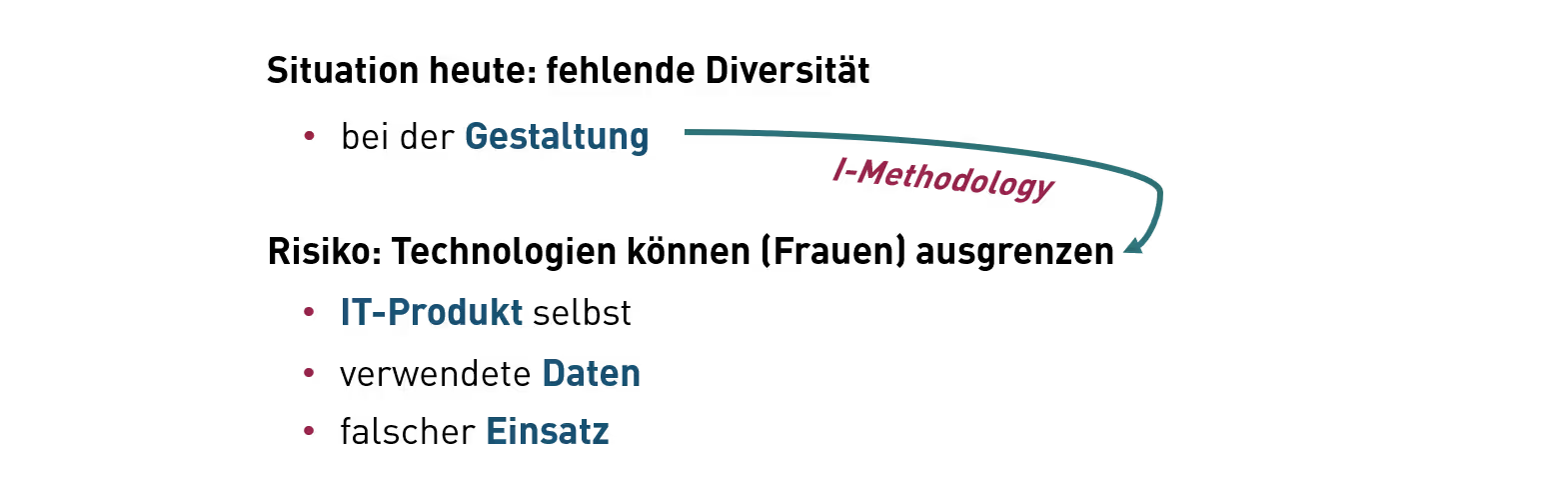
Why can IT become unfair?
The reasons for this are manifold. Sometimes, flawed decisions throughout the development process lead to unfair software when the needs and requirements of end users are not sufficiently considered. This can cause the IT system itself to become unfair. Biased data can make applications based on artificial intelligence unfair. A neutral tool can also develop into unfair technology through misuse , for example, if the underlying process is unfair or unsuitable for automation, or if the framework conditions are exclusionary. All of this can arise from technical limitations or technical errors. Often, the unconscious stereotypes and prejudices of the people involved in the development and deployment of digital technologies can flow into the products, even without malicious intent. One explanation for this is the so-called I-methodology: We tend to project our own experiences onto others. As a result, we develop products that work well for us, but potentially not for other end users. Not all people are equally involved in the design of IT: the IT industry is a male-dominated field. This lack of diversity in the development and deployment of digital technologies explains why, for example, some digital developments can exclude women.
How can digital products be developed and used in a way that respects the diversity of all people?
EAF Expert Lisa Hanstein was invited to a city council hearing of the state capital Munich on July 8, 2021, where she discussed the implementation of gender equality in the city's digitalization strategy with other representatives from the municipal administration, academia, and professional practice. In addition to presenting several very concrete tips, tools, and methods, her keynote speech on "gender-equitable digital services in practice" addressed the fundamental aspects organizations should consider when developing and deploying more inclusive technology.
(Gender) equality as a holistic task
(Gender) equality should not only be a consideration once an IT system is already in use. Instead, it is important to actively integrate diversity and fairness into all phases—from the initial idea, needs analysis, specification, tendering, and procurement or development, to testing, implementation, and operation.
- Diversity of perspectives and participatory development
To meet the specific needs of various end-users, heterogeneous design teams and diverse expertise are essential. Furthermore, as many different user perspectives as possible should be integrated, and one's own stereotypes should be reflected upon. It can be helpful to ask potential users about the requirements for a desired solution and to develop and test the solution together with them. - Focusing on IT: Questioning neutrality and preventing potential discrimination
First, the use of an application should be reviewed. Are the processes or the underlying model of a desired solution fair and inherently gender-equitable? Is the process even suitable for automation, or should decisions be made manually due to error rates? It is also worth looking at the framework conditions: Does everyone have access? Do users receive sufficient support, or is too much technical knowledge assumed? The application itself should also be reviewed. Does the language address everyone equally? Do the images and content used reflect (gender) stereotypes and role clichés? Are the user interface and interactive controls designed so that everyone can navigate them? Is there a balanced gender ratio in contributions and examples? The functions of an IT system should also be checked. Are the basic functionalities fair and gender-neutral? When automated decisions are made based on large datasets, are the data adequately extracted/generated? Are they appropriate and sufficient? Are diversity and quality consistent? - Securing skills for everyone!
Another important point is strengthening the awareness that digital technology is not necessarily neutral and fair, but that it requires active steps toward equality. This primarily requires skills in both IT and equality. This could include, for example, training on gender or unconscious bias for everyone involved in development. However, it also requires IT skills among equality officers so that they can provide even better support and advice. And, of course, it also requires strengthening skills in the specialist departments. Employees must be sensitized to the risks and limitations regarding the gender-equitable use of the city's IT systems and services.

How can the topic of (gender) equality be sustainably and meaningfully anchored in organizations regarding digital applications?
- IT and diversity as a cross-cutting issue
It is important that equality is considered a cross-cutting issue in digitalization projects. Further training and awareness workshops for employees, the IT department, and the equality office can help, as can the provision of information material or the training of guides for such topics. - Cross-functional collaboration & establishing responsibilities
The development and deployment of more inclusive digital products can only be successful through cross-functional and interdisciplinary collaboration. This can include, for example, establishing responsibilities within development teams and creating interdisciplinary focus groups that bring together different departments and perspectives. - Defining guidelines and establishing policies and processes
It is also useful to define guidelines for the fair use of IT and to communicate these both internally and externally. In addition, it can be helpful to establish policies and processes to anchor the identified needs for action within the organization. This includes a systematic, gender-sensitive, and risk-based technology assessment: taking stock, reflecting on existing processes and digital systems and services from the perspective of gender equality, setting concrete and measurable goals, and defining appropriate measures and action plans. Gender-sensitive usability of applications should become a design principle for IT deployment, for example through the development of checklists. It is also helpful to establish review mechanisms to monitor developments and adapt them to new requirements if necessary.
Further information
Further information on the city council hearing and the next planned steps in the state capital Munich can be found here.
In the event series "Shaping digitalization in a gender-equitable way" , EAF Berlin, together with the Third Gender Equality Report Office at ISS e.V. and the Harriet Taylor Mill Institute at the Berlin School of Economics and Law, will address some of the topics raised, particularly in a planned roundtable on "Gender-equitable technology development and design."
Here you can find the Hansestadt Hamburg guide on gender mainstreaming in digital strategies
Kontakt
Wenden Sie sich gerne an die zuständige Ansprechperson:
Lisa Hanstein
Senior Expert

Weitere Einträge in unserem Blog

.png)



Subscribe
the EAF Berlin newsletter
Stay up to date

Would you like to actively implement diversity and equal opportunities in your organization?
There is no "off-the-shelf" consulting process. Therefore, all EAF Berlin's offerings are tailor-made and range from a single strategy workshop to a multi-year project. Our clients benefit from EAF Berlin's broad portfolio: