
Unconscious Bias Training for Companies
Unconscious Bias Training: Overcoming Unconscious Thought Patterns
Learn all about the mechanisms of unconscious thought patterns and break free from stereotypical thinking.
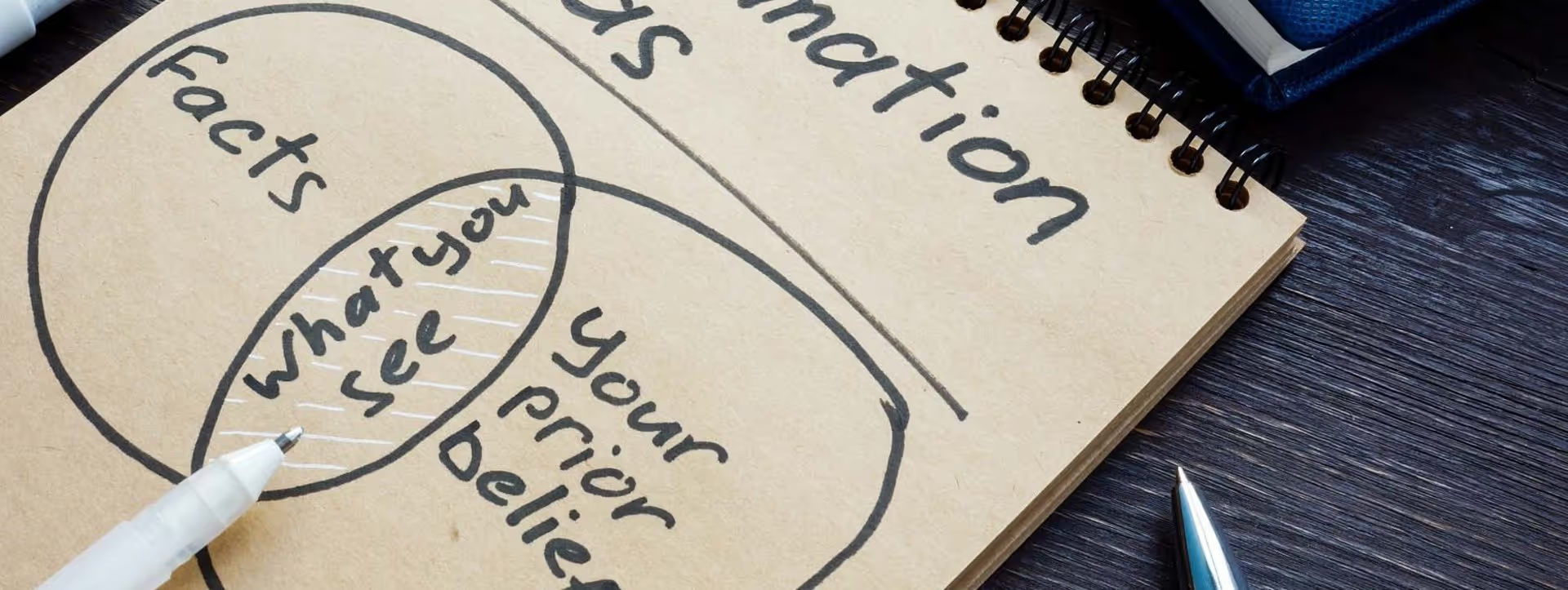
Unconscious biases influence how we view situations, our colleagues, and the potential of others. Our unconscious bias training programs build awareness of these processes, open up new possibilities for action, and support long-term change within organizations.
Your Benefits
Discovering Unconscious Bias
The world is complex, and our brains are wired to conserve energy in our daily lives. Consequently, many thought processes occur automatically. While these automated patterns are helpful in everyday life, they can become problematic when we evaluate others. They lead to stereotyping and prejudice, preventing us from fully recognizing potential and diverse perspectives.

How can I overcome unconscious bias?
Unconscious biases influence our decisions. We all have them; they are part of being human. In our workshops and interactive presentations, we sensitize participants to these patterns and encourage them to reflect on diversity and actively counter stereotyping. Awareness-raising formats like our unconscious bias training are always the starting point for a change process. To be fully effective, they should ideally serve as the prelude to a series of measures aimed at fostering greater diversity.

What is the impact of unconscious bias training?
Our unconscious bias formats empower those who want to drive change, equipping them with the necessary tools and arguments. We operate on the premise that everyone—including our trainers—harbors unconscious biases. This perspective allows us to reach even those who are skeptical about diversity and change. The key to addressing unconscious bias is a willingness to reflect on one's own behavior and, in a systemic sense, to disrupt established patterns. Where this willingness is absent, the workshop cannot have an impact at the individual level.
How our training helps
Our workshops and presentations raise awareness of unconscious thought patterns and demonstrate their impact on daily life. Participants learn to recognize their own biases and develop new ways of acting. We use interactive methods that facilitate exchange, self-reflection, and perspective-taking. Impact is created through openness, collaborative learning, and a willingness to question one's own behavior.
Who is the training for?
Our offerings are designed for organizations that want to improve the quality of their decision-making and promote diversity. In public administration, in particular, unconscious biases can affect recruitment processes, performance evaluations, and funding decisions. Training increases sensitivity to potential biases and sharpens the focus on diverse needs.
UNCONSCIOUS BIAS IN A POLITICAL CONTEXT
Political parties and spaces are not free from discrimination. Stereotypes and prejudices shape party work and influence who we listen to, who we nominate as candidates, and who we approach at information booths. Studies show that prejudice influences voter decisions. Cognitive shortcuts also affect decision-making within party structures themselves.
To remain future-proof, parties must not only recruit new members but also empower existing members and provide them with spaces for reflection. With our training and workshops on unconscious bias in a political context, party members can be sensitized to their own thought patterns and work together to develop ways to make party structures more equitable and inclusive.
This offer is aimed at full-time and volunteer staff in political parties at the local, state, and federal levels.
UNCONSCIOUS BIAS PROGRAMS FOR APPRENTICES AND DUAL-STUDY STUDENTS
Unconscious biases reduce diversity in organizations because they indirectly influence who gets hired, who receives support, and who takes the next step in their career. They also shape which perspectives are brought into the organization, which products are developed, and which customer groups are addressed.
Apprentices and dual-study students often face the prejudice that they make more mistakes than experienced employees. These biases can lead to them being taken less seriously or receiving fewer opportunities to prove themselves.
To change structures in the long term, it is essential to include all employees. Through specially designed training, apprentices and dual-study students can be empowered as diversity ambassadors right from the start of their careers. The training also demonstrates how effective it is when apprentices and managers experience that everyone is pulling in the same direction and views diversity as a shared responsibility.
This program is aimed at apprentices and dual-study students within companies.
UNCONSCIOUS BIAS PROGRAMS FOR PUBLIC ADMINISTRATION
Addressing unconscious bias in public administration is crucial because it improves the quality of decision-making. Unconscious patterns of thought can lead to the discrimination of certain groups, for example, during recruitment processes or the allocation of funding.
Unconscious bias can also impair the quality of performance reviews. By reflecting on their own thought processes, employees can identify potential biases and consciously counteract them. Depending on the requirements, the focus can be placed on topics such as performance reviews, recruitment, or professional development.
Engaging with unconscious bias contributes to promoting diversity in administration in the long term. Employees can better understand and address the needs of different groups, making public services more accessible to more people.
This program is aimed at employees and managers in municipal administrations, as well as state and federal ministries.
Our Formats
1 to 1.5 hours: Interactive Presentation
An interactive presentation is ideal as a kick-off event to spark interest in the topic among a large audience. Methods such as a "thesis barometer" encourage participants to take a stance early on and open up a dialogue on key questions surrounding unconscious bias. Short moments of reflection allow participants to identify their own cognitive biases.
While a presentation raises awareness and inspires, it does not reach the depth of a workshop, as it lacks group work, personal reflection, and concrete transfer phases.
3 to a maximum of 4 hours: Short Workshop
This short workshop combines in-depth knowledge transfer with reflection and collaborative work. Participants engage in plenary discussions, work on tasks in small groups, and develop initial starting points for their own professional context. Awareness of diversity is sharpened, and initial concrete measures are identified.
6 to a maximum of 7 hours: Full-day workshop
A full-day workshop provides space for intensive learning. Content is explored in depth, linked to the organization, and supplemented by case studies, self-reflective exercises, and practical tools. Participants identify existing stereotypes, develop potential solutions, and strengthen their role as multipliers. The Inclusive Leadership concept can be integrated upon request.
Two-part format: Two short workshops spaced four weeks apart
This combination is particularly sustainable. In the first workshop, participants are sensitized and receive a concrete task for their daily practice. In the follow-up workshop, they reflect on their experiences, discuss questions, and deepen their strategies. This temporal structure creates a more lasting learning effect.
If you have any questions, please feel free to contact me!
.jpg)

Ready for real
change?
The format is available both digitally and on-site.
Your contact person
Please feel free to contact me if you have any questions!
Frequently asked questions
Answers to our training programs.
Subscribe
the EAF Berlin newsletter
Stay up to date

Other offerings from EAF

Diversity & Inclusion Survey - measure, analyze, improve

Inclusive Leadership

Leading in Challenging Situations

Bits & Bias – Shaping Equitable Digitalization

.avif)