
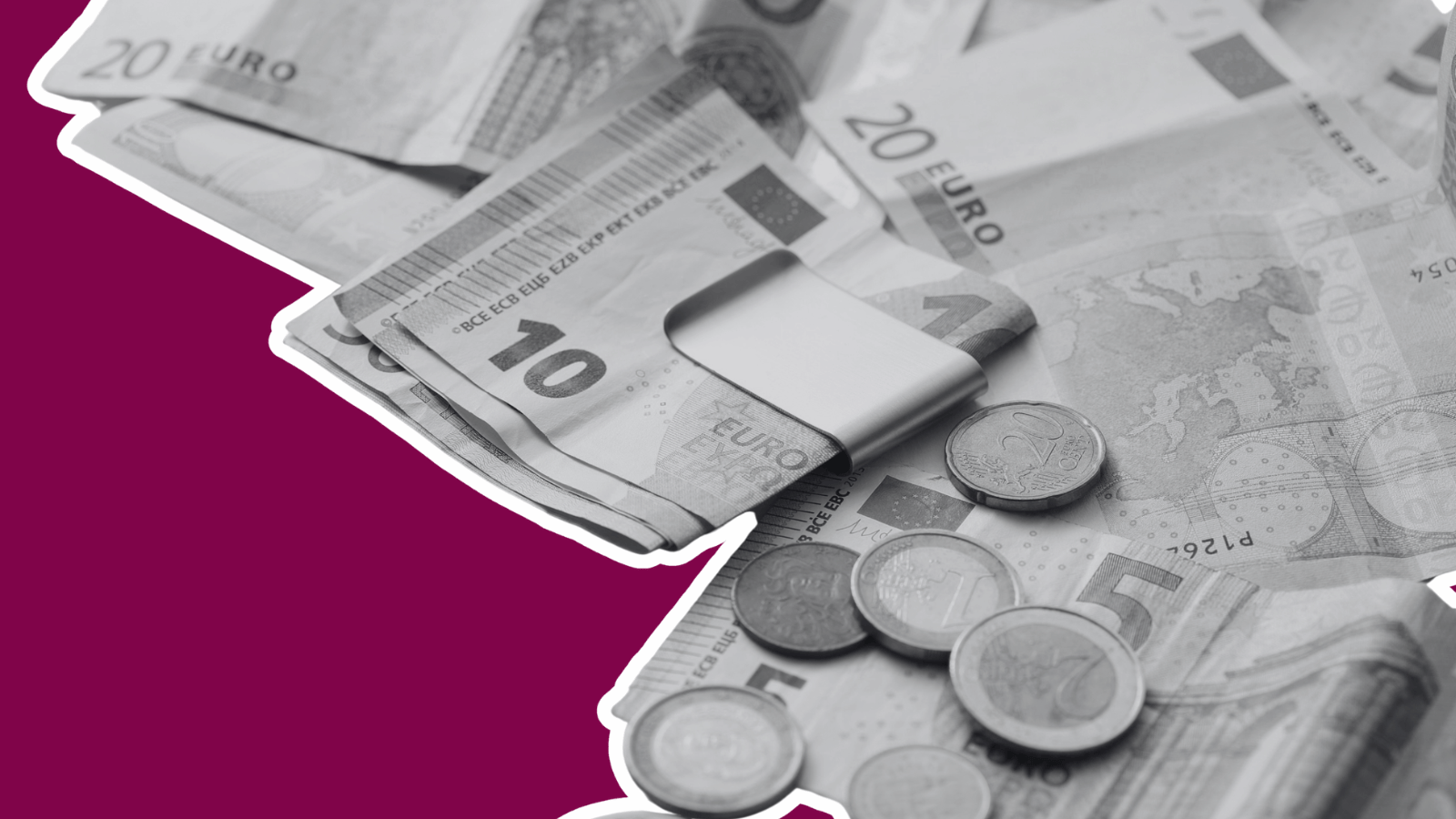
Economic independence is a key prerequisite for social participation, self-determination, and autonomy. It enables people to make their own life choices and represent their interests independently. It also plays an important role in the prevention and management of violence, as financial dependence can make it difficult to leave stressful or abusive relationships.
However, economic gender equality is still far from being achieved. This not only has negative consequences for the German economy but can also threaten the immediate safety and physical integrity of women. Economic dependence can increase the risk of remaining in abusive relationships and often makes it harder for victims to escape violent situations.
On average, women still earn 16 percent less than men (Statista, 2025). According to statistics, 46.9 percent of the workforce in Germany are women, yet only 29 percent of all management positions are held by women (Destatis, 2026). A large proportion of working-age women work part-time. The gender lifetime earnings gap is 45 percent (Bönke et al., 2020).
Looking at current debates on pension policy, it is particularly interesting to examine the gender pension gap, which currently stands at 27 percent in Germany (Destatis, 2024). On average, women receive nearly a third less in retirement income than men. This is due, among other things, to lower earned income, more frequent career breaks, and the unequal distribution of unpaid care work (Weßler-Poßberg, Ehrentraut, 2025).
How does economic dependence affect people?
But what is far more critical is the precarious situation in which many women find themselves due to dependence in their romantic relationships. Having to finance their home and livelihood binds many women involuntarily to their partners, which is particularly dangerous with regard to protection against domestic violence. Every day in Germany, at least two women become victims of an attempted or completed homicide. Referring to this, the federal chairman of the Association of German Criminal Investigators gave the following advice on ZDF-heute journal sarcastically advising all women not to enter into a relationship with a man, as this significantly increases the risk of becoming a victim of physical or psychological violence.
18 percent of all women experience violence within their romantic relationships during their lifetime. This figure alone is disturbing, but it becomes significantly more alarming when one realizes that fewer than five percent of all cases are reported (LeSuBiA, 2026). Out of fear, many victims remain silent and stay in their abusive relationships – partly because they are not financially able to leave their shared home.
An intersectional perspective refines the analysis
Economic disadvantage can contribute to women having less room for maneuver to protect themselves from violence or to leave abusive relationships. The right to physical integrity is not only a fundamental right but also a human right.
Furthermore, the classist dimension of economic inequality is central to understanding it. Women are affected by economic dependence to varying degrees. The consequences of this dependence and how the resulting violence manifests itself depend significantly on one's respective socioeconomic position.
Recently, at re:publica 2026, during an event with author Mareice Kaiser, a blue-collar worker spoke about how she was able to secure a 200-euro pay raise through a strike. These 200 euros were the deciding factor that allowed her to leave her violent partner. Economic background significantly shapes how women experience economic dependence, what consequences it has for their daily lives, and what options are available to them. Economic inequality therefore does not affect all women in the same way. While women affected by poverty and classist discrimination are often more severely impacted by the consequences of economic dependence, women with higher incomes or a privileged economic background often have different material resources to break free from abusive relationships.
What is already being done?
Federal Justice Minister Stefanie Hubig (SPD) is currently working on a draft law to abolish the mandatory one-year separation period in cases of domestic violence (tagesschau, May 17, 2026). Currently, waiving this mandatory separation period is only possible in exceptional cases. The proposed law aims to ensure that women experiencing violence in their relationships do not have to wait an additional year to separate from their abuser.
Work is also underway to implement the federal Violence Protection Act (Bundestag, 2025). Related support systems, such as counseling centers and educational projects, are to be supported and expanded with financial resources. This is fundamentally necessary in light of budget cuts in the education sector, which affect organizations like the Berlin Initiative Against Violence Against Women (BIG Prevention). Women must have a right to protection. Consequently, safe spaces and women's shelters must be expanded and enhanced as places of refuge. Furthermore, the law includes measures for raising awareness about domestic violence and available support services.
However, these important approaches only address the consequences and do not sufficiently tackle the (economic) root causes of violence against women.
In this regard, the Federal Ministry for Family Affairs has published the "2030 Strategy Framework for Economic Equality," which explicitly states: "Equality must be understood in material terms" (Sacksofsky, 2025). To achieve this equality, it is necessary to overcome traditional gender roles, abolish negative incentives for women's employment (e.g., the spousal tax-splitting system), and not only make unpaid care work compatible with paid employment but also distribute it fairly.
The strategy framework specifically identifies the resulting problem: "Economic dependence creates further dependencies" (BMBFSFJ, 2025). Therefore, economic independence is one of the most important—if not the most important—cornerstones for an independent, self-determined, free, and secure life for women.
Economic inequality is violence in itself
Beyond the fact that many women are exposed to physical danger due to their economic dependence, economic inequality can itself be a form of violence. This is not least because, in specific cases, it often occurs in conjunction with sexual or physical violence (Walby, 2017; Verfassungsblog, 2025).
By controlling finances, it is deliberately made difficult for women to end relationships with violent partners, escape physical violence, and live self-determined lives. Although this form of violence is explicitly addressed in the Istanbul Convention, which Germany ratified in 2017, it receives little attention in theoretical discourse or in the establishment of effective measures. The Convention defines violence as "all acts [...] that result in, or are likely to result in, physical, sexual, psychological or economic harm or suffering to women" (Istanbul Convention, 2018).
Patriarchal violence and the structural discrimination of women, particularly regarding unequal economic independence, constitute a problem of violence. These structural inequalities are partly responsible for women being exposed to physical, digital, or sexual violence. Economic self-determination is crucial for ensuring that women's human rights are upheld and enforced.
This is precisely why it is vital that the economic independence of all genders continues to be fought for and defended. The primary goal is to protect vulnerable groups from violence and to uphold the long-established rights of women—rights that must not be up for debate or further restricted.
More information on the topic:
Further information on the topic of economic independence can be found in the action week "Standing on Your Own Two Feet Financially: The 2026 Nationwide Action Week" organized by the Federal Ministry for Family Affairs.

Bibliography:
ARD Mediathek (May 15, 2026): Equality – Are we equal? Available at: ARD Mediathek Accessed: May 29, 2026.
Bertelsmann Stiftung (2020): Who wins? Who loses? The development and forecast of lifetime earnings in Germany. Gütersloh: Bertelsmann Stiftung. Accessed: May 29, 2026.
Federal Criminal Police Office (BKA) – LeSuBiA (2026): Thematic Issue I: Results of the dark field study "Living Situation, Safety and Stress in Everyday Life (LeSuBiA) I" - Experiences of violence within and outside of (ex-)partnerships Wiesbaden: Federal Criminal Police Office. Accessed: May 29, 2026.
Federal Ministry of Education, Family, Seniors, Women and Youth – Strategy Framework 2030 (2025): Strategy framework for economic equality 2030. Berlin: BMBFSFJ. Accessed: May 29, 2026.
Federal Ministry for Education, Family, Senior Citizens, Women and Youth – Violence against women (2018): Act on the Council of Europe Convention of 11 May 2011 (Istanbul Convention) Berlin: BMBFSFJ. Accessed: 29/05/2026.
BMBFSFJ PDF – Permanently unequal (2016): Permanently unequal: Occupation-specific lifetime earnings of women and men in Germany. Berlin: BMBFSFJ. Accessed: 29/05/2026.
German Bundestag PDF (2025): On the implementation of the Violence Support Act by the federal states. Berlin: German Bundestag. Accessed: 29/05/2026.
Destatis – Women in the workforce (2026): Participation of women in the workforce. Wiesbaden: Federal Statistical Office. Accessed: 29/05/2026.
Destatis – Gender Pension Gap (2026): Gender Pension Gap. Wiesbaden: Federal Statistical Office. Accessed: 05/29/2026.
JSTOR Chapter – Conceptualising Violence and Gender: Walby, Sylvia et al.: Conceptualising Violence and Gender (2017). In: The Concept and Measurement of Violence. Bristol: Bristol University Press, pp. 31–56. Accessed: 05/29/2026.
Statista – Gender Pay Gap in Germany (2026): Gender Pay Gap: Earnings gap between men and women in Germany from 2000 to 2024. Hamburg: Statista. Accessed: 05/29/2026.
Statista – Violence against women (2026): Domestic violence and violence against women in Germany – Facts & Figures. Hamburg: Statista. Accessed: 05/29/2026.
Tagesschau – Divorce law (2025): Hubig seeks changes to divorce law. Hamburg: tagesschau.de. Accessed: 05/29/2026.
Verfassungsblog – Economic domestic violence (2025): Economic domestic abuse. Berlin: Verfassungsblog. Accessed: 05/29/2026.
ZDF – Unbubble (n.d.): Unbubble. Mainz: ZDF. Accessed: 05/29/2026.
Kontakt
Wenden Sie sich gerne an die zuständige Ansprechperson:
Anne Reich
Student Assistant

Weitere Einträge in unserem Blog

Subscribe
to our newsletter
Stay up to date

Would you like to actively implement diversity and equal opportunities in your organization?
There is no "off-the-shelf" consulting process. Therefore, all EAF Berlin's offerings are tailor-made and range from a single strategy workshop to a multi-year project. Our clients benefit from EAF Berlin's broad portfolio: