
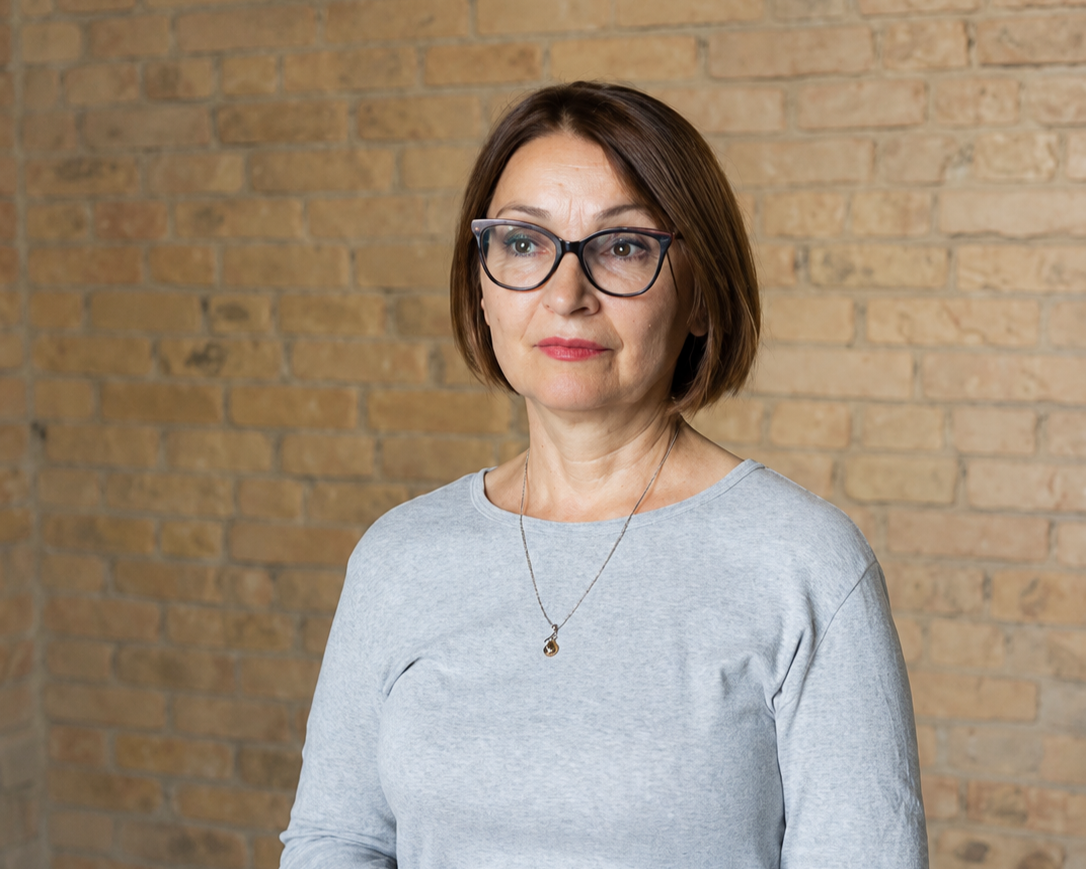
NOTE: EAF Berlin is continuously committed to supporting women's organizations in Ukraine. We are very pleased to be able to support the outstanding work of Numo Sisters! with a donation of 2,500 euros from the EAF friends' circle. Led by journalist Liudmyla Huseinova, Numo Sisters! is a self-help organization for formerly detained journalists and civilians that provides mutual support, post-traumatic therapy, and vital public advocacy. Their solidarity also extends to the many women still being unlawfully detained in Russian-occupied territories.
Helga Lukoschat first learned about the organization at this year's UN Commission on the Status of Women in New York. When Liudmyla Huseinova was recently in Berlin, Yuliia Siedaia was able to speak with her about her experiences and activities. Yuliia Siedaia is a sociologist with a PhD and a gender expert. She is from Kharkiv, currently lives in Berlin, and is an "Associated Expert" with the EAF.
We are publishing this article on the occasion of the International Day for the Elimination of Sexual Violence in Conflict.
______________________________
When the bag was pulled off her head, she cried. From pain, from fear, from the sudden reality of the situation. Then she made a decision that would carry her through three years and thirteen days—the duration of her imprisonment: never show weakness.
Liudmyla Huseinova is a human rights defender, founder of the organization "Come On, Sisters!" (Numo, Sestry!), and a former civilian prisoner of war. After her release from Russian captivity, she could have retreated. She did the opposite: she stepped into the public eye—on Ukrainian stages, before the UN Security Council, and in conversation with the Pope. Not to talk about herself, as she emphasizes, but to speak for those who are still there.
"I think every day about those who are still there. About the women and girls I know personally. It hurts to know that we still cannot bring them home."
Since the start of the full-scale Russian invasion in February 2022, the unlawful detention of Ukrainian civilians has become one of the most serious and least documented aspects of this war. Thousands of people—not soldiers, not combatants—have been abducted, arbitrarily held, or have become victims of enforced disappearance.
According to the Ukrainian Parliament Commissioner for Human Rights, Dmytro Lubinets, approximately 28,000 Ukrainian civilians were in Russian captivity as of the end of 2025, including more than two thousand women. Most are held without formal charges, legal counsel, or contact with their families. This is a state of affairs that constitutes a grave breach of the Fourth Geneva Convention under international law.
It is no coincidence who gets arrested. Russian security forces specifically target individuals who show pro-Ukrainian sentiments or maintain local structures: volunteers, activists, local government representatives, journalists, and those who helped with evacuations from occupied territories.
Human rights organizations have documented a clear pattern: mass arrests are not just for punishment, but for intimidation. A person who disappears without a trace leaves behind deep uncertainty in their community. The message to the rest of the population is unmistakable: resistance has a price.
Many arrests take place during so-called "filtration" measures—systematic screenings where occupation authorities vet civilians for political loyalty. Those deemed unreliable disappear into detention centers, makeshift camps, or are deported to Russia. Fabricated accusations of espionage, extremism, or terrorism sometimes serve as the legal "justification."
What makes many cases particularly dramatic is that relatives often go months without knowing if the missing person is still alive, let alone where they are being held. Total isolation—complete cutting off from the outside world—is standard practice. Lawyers are denied access, family members receive no information, and human rights organizations are unable to intervene.
Under such conditions, abuse and torture thrive. Reports from released civilians describe physical violence, sleep deprivation, and psychological pressure.
Huseinova describes captivity as a state of constant physical and psychological survival. To survive it, one must shut off their emotions. This shutdown does not end on the day of release. When she came home, she waited for the emotions she had suppressed for years. They didn't come. She was afraid of everyday situations, her phone, or supermarkets.
"In the first six months, the body survives on what I call the 'prison reserve.' Then everything starts to fall apart."
Years of immobility in her cell left her with permanent leg problems. Throughout her entire imprisonment, she was barely allowed to leave her cell. She mentions this not as a complaint, but as evidence: what happens in prison stays in the body.
What she saw there
Huseinova was detained at the Donetsk detention center as well as the notorious "Izolyatsia" prison, which has been documented as a torture center by Russian occupation authorities since 2015. She remembers how Ukrainian prisoners of war were driven through the corridors: hands bound, bags over their heads, bleeding wounds. The guards beat them and forced them to sing Russian propaganda songs.
What is often forgotten is that these practices did not begin with the 2022 invasion, but rather with the illegal annexation of eastern Ukrainian territories in 2014. However, the situation deteriorated dramatically after February 24, 2022. Care packages were banned, and lawyer visits were cancelled. Information isolation became an additional tool of pressure. The guards would taunt the prisoners:
"What kind of exchange are you waiting for? Soon, everything will belong to Russia."
At the same time, more and more prisoners of war were arriving. Cells were cleared—often without any basic sanitation—and refilled. Physical violence and psychological abuse became the norm.
While at least rudimentary exchange mechanisms exist for prisoners of war, civilians are largely excluded from them. International law does not permit their detention as prisoners of war, yet the Russian Federation often refuses to even acknowledge their captivity. This creates a hopeless spiral: no recognition means no record, and no record means no exchange.
Some people are released after long periods of detention: without explanation, without documents, without financial means, and often without any safe way to return to Ukrainian-controlled territory. Release is not the end of their ordeal.
Sexualized violence: Broader than the term suggests
A particular brutality is evident in the treatment of female detainees. Human rights observers have documented cases in which women were forced to sign false confessions under the threat of having their children taken away and placed in orphanages.
"I only agreed once they threatened to take my children away."
– Released prisoners from the Izolyatsia prison in Donetsk
Conflict-related sexualized violence remains a largely taboo subject. United Nations reports confirm that sexualized violence is used against both women and men in detention facilities and occupied territories. Survivors often remain silent for fear of social stigmatization.
Huseinova is one of the few who speaks publicly and precisely about the spectrum of conflict-related sexualized violence—and she points to a fundamental misunderstanding: neither the Ukrainian public nor the international community truly grasps what the term means.
Sexualized violence in detention encompasses far more than rape: forced nudity, sexualized humiliation, electric shocks to the genitals, threats against children, and coercion involving family visits. Many survivors did not realize that what happened to them even fell under this definition.
"Many survivors did not even realize that what they experienced constituted conflict-related sexual violence."
Huseinova emphasizes: Sexualized violence in captivity is not driven by sexual desire, but by humiliation, dominance, and the deliberate attempt to break a person psychologically. It is a tool—just like hunger, isolation, or sleep deprivation.
"Every blow must be documented. Every person who has beaten, tortured, or denied aid must be held accountable."
What comes after release
Post-traumatic stress disorder, social isolation, economic hardship, and bureaucratic hurdles in obtaining replacement identification documents—former civilian prisoners face a host of severe challenges upon their return. Long-term psychological care is barely accessible to many.
The consequences for women are particularly grave. Those who have spent years without proper hygiene and medical care often suffer from serious health issues, including reproductive health complications. Huseinova puts it bluntly:
"Many lose the ability to have children. Yet, there is still no state-funded examination or treatment program specifically tailored to these women."
The urgent need for dental care is also barely being addressed. Many former prisoners have lost their teeth or suffered severe damage as a result of torture. A state system to provide this support does not yet exist in Ukraine. Most aid programs run exclusively thanks to international funding.
Sisterhood as Healing
Huseinova has built an organization out of her own history.
"Come On, Sisters!" (Numo, Sestry!) was officially registered in December 2024, though the idea had been around for much longer. The organization brings together women who have survived imprisonment, occupation, or war-related violence—and also supports those who are still being held. Its core mission: not just help for those who have returned, but pressure for those who have not.
The areas of work include rehabilitation programs, legal advice, and the training of legal advocates—survivors themselves who now help others document crimes and navigate legal proceedings—as well as international lobbying. The organization cooperates with UN Women Ukraine and JurFem, among others.
Among the few bright spots Huseinova reports is a fifteen-day rehabilitation program in Transcarpathia, carried out with international support. It combined psychological counseling, art therapy, and medical examinations in a safe environment. The women arrived reserved and suspicious. Gradually, they opened up.
"The most important thing was the feeling of sisterhood. The women realized they were not alone."
What works is not short-term intervention, but long-term support. After the program ended, the participants stayed in contact with each other and with psychologists online. This continuity, Huseinova says, is crucial.
In 2022, the Ukrainian government and the United Nations signed a framework agreement to combat conflict-related sexual violence and support survivors. Several countries and international jurisdictions have initiated war crimes proceedings. These are important steps. But they are not enough.
A Question of International Security
The detention of Ukrainian civilians is not a peripheral phenomenon of the war. It is an instrument of hybrid warfare: physical violence combined with psychological, social, and informational control. To intimidate a community, you don't have to target everyone—it is enough to make the right people disappear.
In modern warfare, civilians are no longer just incidental victims. They have become targeted objectives. The fact that the international community still treats this issue as secondary is not just a humanitarian failure. It is a strategic one.
What is needed: systematic documentation that does not just begin in 2022. Exchange mechanisms that include civilians. A state-funded rehabilitation system in Ukraine. And international accountability—not just for military personnel, but for everyone who held responsibility within this system.
Huseinova’s family home in Novoazovsk was looted after the occupation. She does not want to go back. She has read the denunciations that neighbors wrote about her.
"I am not looking for revenge. But I do not want to live among them."
Her dream is a home in a free Ukraine. Her goal is to get all the civilians still being held released—and to leave behind a system for those who return that truly supports them.
On June 19—the International Day for the Elimination of Sexual Violence in Conflict—Liudmyla Huseinova is one of many voices reminding us what lies behind the numbers: 28,000 people. More than two thousand women. Each with a name. Each with a story.
Huseinova continues to speak out. Until they are all home.
Kontakt
Wenden Sie sich gerne an die zuständige Ansprechperson:
Dr. Yuliia Seidaia
Associated Expert
Weitere Einträge in unserem Blog
.png)


Subscribe
the EAF Berlin newsletter
Stay up to date

Would you like to actively implement diversity and equal opportunities in your organization?
There is no "off-the-shelf" consulting process. Therefore, all EAF Berlin's offerings are tailor-made and range from a single strategy workshop to a multi-year project. Our clients benefit from EAF Berlin's broad portfolio: