

Nationwide, the proportion of women in local representative bodies is only 30 percent. A look at the individual federal states reveals significant differences: Saxony is at the bottom of the national ranking with just 22 percent. The study "Women's Engagement in Local Politics in Saxony" by EAF Berlin sheds light on the causes and provides far-reaching recommendations for action. The study was commissioned by the Saxon State Ministry of Justice and for Democracy, Europe and Gender Equality (SMJusDEG) and conducted by Kathrin Mahler Walther, Anna Sive, Lisa Hempe, and Dr. Helga Lukoschat.
The study's findings present a nuanced picture of the current situation in Saxony: On one hand, there is a strong civil society with many motivated and committed women, meaning there is great potential for strengthening women's representation. The increased number of female candidates for the 2024 local elections underscores this. On the other hand, the increasingly polarized political and social climate, along with the associated hostility and threats, represents a growing barrier to local political engagement for women and marginalized groups. This challenging political situation sometimes deters women from getting involved in local politics. At the same time, however, it also leads to an intensification of democratic engagement—a "now more than ever" attitude. Several long-standing officeholders decided to run again for this very reason. Many women are involved in one of the numerous initiatives and alliances for openness, tolerance, and solidarity.
"There are people everywhere here who hold completely different values. And the goal, of course, is for them to become vocal too, and for all of Germany to see: Saxony isn't just blue, and there are many, many people doing something about it and feeling angry about it. Our beautiful region, which is so worth living in and has so many wonderful opportunities. [...] I think it's all the more important to really say: 'I'm not just getting upset about this, I'm looking at what I can do within my means.'"
(Study participant, civil society focus group, rural region)
Essential: Initiatives to reach and empower women
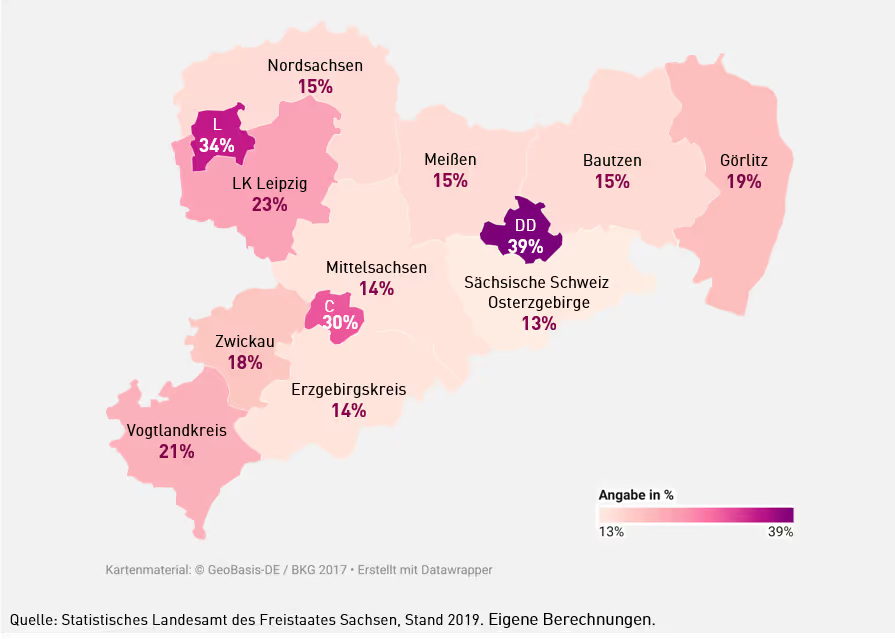
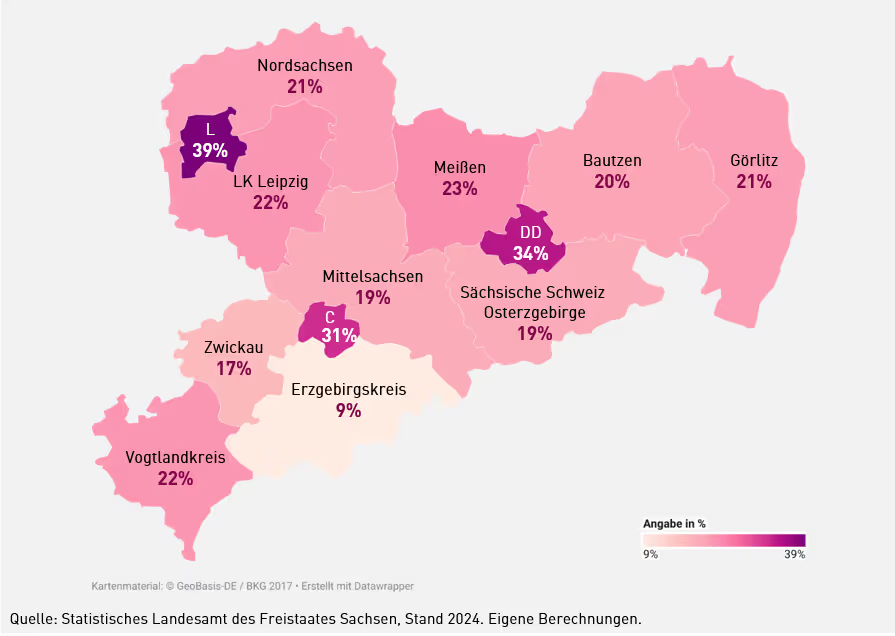
The proportion of women in local politics in Saxony rose slightly to 22 percent in the 2024 local elections, up from 20 percent previously. This is particularly significant in regions where many programs and events were held to empower and motivate women. In districts with high levels of such activity, the proportion of women increased by up to 8 percentage points—as seen in the Meißen district council. It is therefore not only worthwhile to invest in measures to reach women; it is a necessity. While women's representation increased in six districts, it fell in four others—most significantly by 5 percentage points in the Erzgebirgskreis, as a comparison of Figures 1 and 2 shows.
Additional hurdles: Structural framework conditions
The reasons for the low and, in some regions, declining representation of women lie not only in the intensifying political and social climate but also in the structural framework conditions for local political engagement. These include deeply rooted social role models that lead to challenges in balancing work and private life and to the exclusion of women in politics. Almost all women interviewed for the study reported experiences of sexism. They encounter it within parties, in councils, on the street, and in the media. Women rely on their substantive expertise to gain a hearing and acceptance, and they set clear boundaries against sexist attacks. This requires a great deal of energy and represents an additional arena of self-assertion alongside the arena of substantive debate in the council. Further complicating factors include long meeting times in the evening, time-consuming preparations, and additional on-site appointments with citizens. These require a reduction in professional activities, which is often not compensated for by the very low expense allowances. Furthermore, reducing working hours also leads to losses in pension provisions. Given these challenges, many women simply cannot afford to be involved in local politics.
What needs to be done? Recommendations for promoting the representation of women
Based on the study results, EAF Berlin has developed recommendations for action. These are understood as interconnected aspects of an overall strategy that addresses the diversity of women and their respective obstacles. They are aimed at a range of stakeholders in municipalities as well as at the state and federal levels, including municipal associations, civil society actors, and political parties. They all must contribute to strengthening a gender-equitable, diverse representation of the population in local politics, thereby ensuring the future viability of this engagement, which is so important for the community. The recommendations for action cover the following areas:
- Enable a wide range of political education and participation opportunities for children, young people, and adults
- Provide resources to strengthen civil society—many local female politicians find their entry point and motivation through civil society engagement.
- Strengthen equality structures – municipal equality officers need the time and financial resources to fulfill their key role at the local level.
- Create non-partisan programs and measures to encourage, inform, and network women.
- Actively reach out to women and other underrepresented groups through political parties, and create a welcoming culture and structure.
- Improve institutional frameworks, for example by enabling hybrid meetings and establishing consistent, appropriate compensation across the state.
- Ensure effective protection against insults and threats in the council, in personal life, and online.
- Adopt an intersectional perspective to address and dismantle the specific barriers faced by different groups of women.
Study design
For the qualitative study, individual interviews and focus group discussions were conducted between October 2023 and March 2024 with the following target groups from all districts and independent cities in Saxony:
- Female officeholders and elected representatives
- Female party members without a local political mandate
- Women active in civil society without a local political mandate.
- About the study: Women's engagement in local politics in Saxony.
The authors of the study
- Kathrin Mahler Walther is the Executive Chair of EAF Berlin and advises organizations in business, politics, and academia on promoting diversity in leadership.
- Anna Sive is a Senior Expert with a focus on research and organizational development. Her work centers on the data-driven development of initiatives and projects.
- Lisa Hempe is a Senior Expert specializing in democracy promotion, participation, migration, and politics. She coordinated the "Action Program Municipality – Women into Politics!" funded by the BMFSFJ.
- Dr. Helga Lukoschat is a volunteer board member and Senior Advisor at EAF Berlin.
About the study
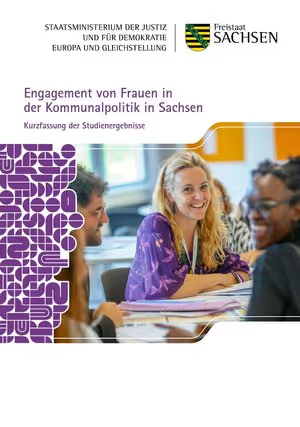
The study and its executive summary can be downloaded via the following link, and printed copies of the summary can be ordered free of charge: publikationen.sachsen.de/bdb/artikel/45662.
Further information
- This blog post was previously published in: Zeitschrift des Deutschen Städte- und Gemeindebundes E.V. "Stadt und Gemeinde digital", issue: 6/24. The article can be read here: https://www.dstgb.de/publikationen/dstgb-magazin/stug-digital-ausgabe-nr.-06-2024.pdf?cid=10p1.
- During a digital expert forum on February 11, 2025, from 7:30 p.m. to 9:00 p.m. study authors Kathrin Mahler Walther and Anna Sive will present the findings and recommendations of the study "Women's Engagement in Local Politics in Saxony."
Kontakt
Wenden Sie sich gerne an die zuständige Ansprechperson:
Kathrin Mahler Walther
Executive Chair
_neu.jpg)
Weitere Einträge in unserem Blog




Subscribe
the EAF Berlin newsletter
Stay up to date

Would you like to actively implement diversity and equal opportunities in your organization?
There is no "off-the-shelf" consulting process. Therefore, all EAF Berlin's offerings are tailor-made and range from a single strategy workshop to a multi-year project. Our clients benefit from EAF Berlin's broad portfolio: