
Everyday life, joy, grief – a journey into a country at war

EAF Senior Advisor Dr. Helga Lukoschat traveled to Ukraine in early July 2023. Here, she reports on her experiences, the people she met, and the need to support Ukrainian women in their activism and in their preparations for the country's reconstruction.
In early July 2023, I visited Ukraine for the second time, this time traveling to the south: to Odesa and the district town of Dobroslav, located 60 km to the northwest, at the invitation of Mayor Lyudmyla Prokopechko. At the EAF, we had once again collected donations for our partners and their organizations. I had the pleasure and honor of delivering them in person.
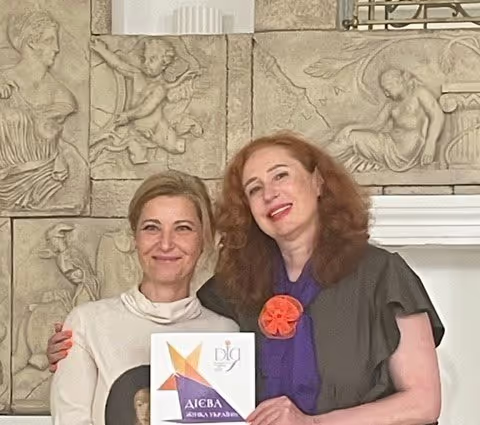
In Odesa, Natalya Deliyeva, chair of the women's organization Diya, is active in humanitarian aid and in supporting volunteer associations and the army. Mayor Lyudmyla Prokopechko is supported in her international contacts by Kharkiv-based sociologist Yuliia Siedaia. All three were partners in the project "Together for Democracy," which EAF Berlin carried out in cooperation with the Konrad-Adenauer-Stiftung.
Culture and Joy as Forces of Resistance
What does it feel like to travel to a country at war? That is a question I have been asked often in recent days. The most profound experience for me was realizing that everyday life, joy and sorrow, beauty and destruction exist in unimaginably close proximity. In Dobroslav, for instance, a town festival had to be cut short due to an air raid siren—we found ourselves in a bomb shelter. That same evening, we received the news that the 27-year-old brother of a municipal employee had been killed at the front after just two months of service. Fortunately, Dobroslav has not (yet) been the victim of a missile or drone attack. In Odesa, however, the port in particular is constantly in the crosshairs of Russian attackers.
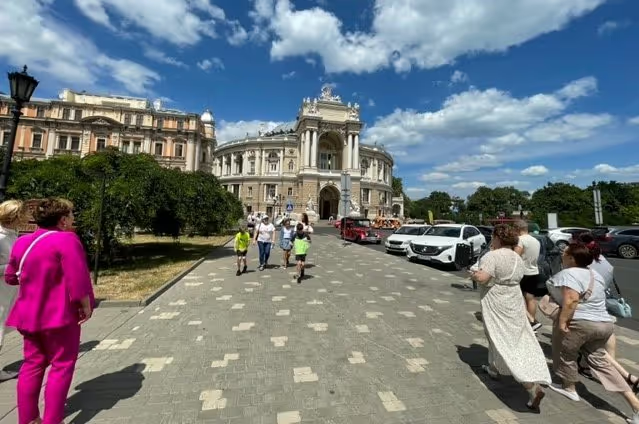
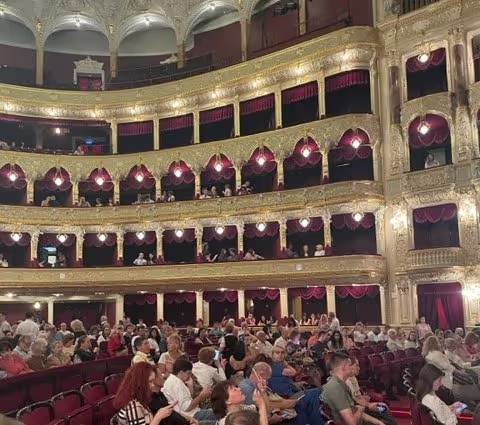
Odesa is a vibrant, beautiful city. The impressive opera house, modeled after the Semperoper in Dresden, remains open, allowing us to attend a performance of Carmina Burana. The choir, singers, and dancers delivered a top-tier performance and rightly received a standing ovation in a house that was filled almost to capacity. The performance began at 4 p.m., however, as attacks usually occur at night. Security protocols are announced in advance; the audience remains calm and disciplined.
The commitment to maintaining one's own culture and way of life as much as possible is also a form of resistance, courage, and determination with which the population defends its country. "We are the second front," I heard from many people working in city administration, infrastructure, or civil society. A restaurant owner in Odesa also explained that keeping the restaurant open and serving fine Italian cuisine was born out of a defiance to not yield the field to the Russian obsession with destruction.
Material Aid and Human Connections
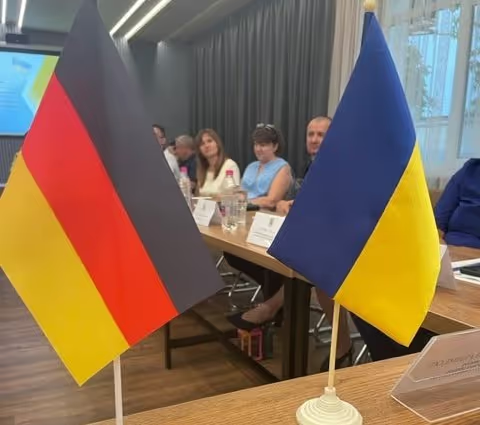
My visit was, not least, in the context of EAF Berlin's new project, "She Can – Strengthening Women in Ukrainian Municipalities," which builds on our previous engagement. In this project, funded by the Federal Foreign Office, we are partnering with the civil society organizations Austausch e.V. and Dialogue for Understanding (D4U). The goal is to initiate municipal partnerships with five Ukrainian cities or regions and to forge networks between women active in local politics and civil society in Germany and Ukraine.
Personal exchange is central. Not only to support Ukraine in its reconstruction after the war ends, but also now, in these critical times. It is also important so that we in Germany, as our partners repeatedly emphasized, "do not grow weary of the war." There is a genuine concern about that. "We are very grateful for your material aid. That is one thing. The other is the human connection," were the poignant words of a city councilor in Dobroslav.
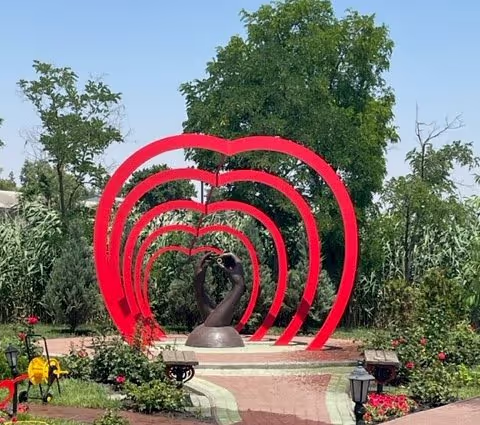
This rural town, the center of a settlement area with around 16,000 inhabitants, is one of the municipalities for which we are seeking a German partner community. The area was only formed in the course of the 2020 decentralization reform. Since then, Mayor Lyudmyla Prokopechko, one of the leading activists in Odesa during the 2013/14 Maidan, has achieved a great deal. To improve the quality of life, parks have been laid out, streets paved, and businesses established. In a previously neglected village, roses are now being grown on large hectares of land, and a literally flourishing trade has emerged. The installation of wind farms would also be an obvious step. The areas are large, and the wind blows constantly from the Black Sea. But investors are still lacking.
New Opportunities for Female Policymakers
Decentralization has created smaller, less powerful units. Women have gained the chance to take on leadership positions. Furthermore, in the course of the 2020 local elections, a 40 percent gender quota was introduced for candidate lists for city and municipal councils. However, these requirements are still too often circumvented by parties or only met pro forma. I was told of individual cases where women were offered significant sums of money to "voluntarily" vacate their seats.
There is still much to do. But the prospect of EU membership provides an effective incentive to improve gender equality and pursue an active equal opportunity policy. The Ukrainian government intends to appoint "gender advisors" in municipalities in the future, though these will be honorary positions. The experience with municipal equal opportunity officers in Germany, who are part of the institutional structure and generally work full-time, was therefore met with great interest by those I spoke with.
In addition to the pressing issues of housing internally displaced persons, maintaining economic activity, and ensuring medical care, these concerns are also receiving attention. Combating domestic violence, which has continued to increase over the past year, is high on the agenda. In Dobroslav, the city administration would like to create mobile teams to visit families on-site. A shelter for affected women and children is planned—though this is no easy undertaking given the housing shortage. The psychosocial support for members of the army returning from the war and the treatment of trauma remain major issues. Ukraine lacks trained personnel: psychologists and doctors are being trained in expedited programs at best. Here, too, German municipalities could provide support through professional guidance or by hosting and treating affected individuals, provided they have the appropriate facilities.
30 percent women in the armed forces
The army and volunteer associations are held in high regard, which is clearly palpable in personal encounters. "Thank you for defending us," people say with deep conviction. Russia's war against the country has now been going on for over 500 days. In the cityscape of Odesa, I noticed large posters advertising the army, quite martial in style, reminiscent of American action movies. By my estimate, every fifth poster featured a woman. Their share in the armed forces is approximately 30 percent.
Women should play a strong role in reconstruction
Women are involved on all fronts. If we want Ukraine to have a democratic and economically prosperous future, it is essential that women play a strong role in reconstruction, especially in political leadership positions.
Ukraine belongs to Europe and the EU, and it belongs in NATO. Even if accession is currently not possible for many reasons, the security guarantees of the G7 states must be strong and robust. We must not slacken in our attention and support – at all levels: military, financial, and human. The price that Europe and Germany would otherwise pay in the medium and long term would be very, very high.
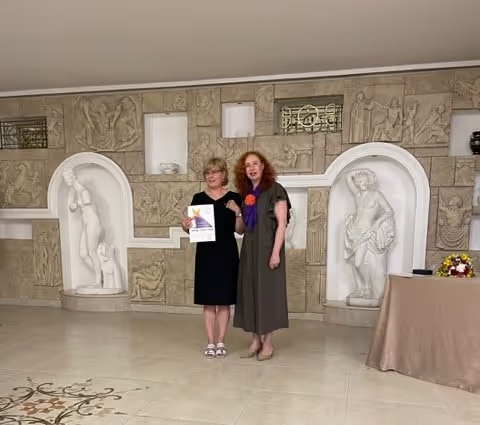
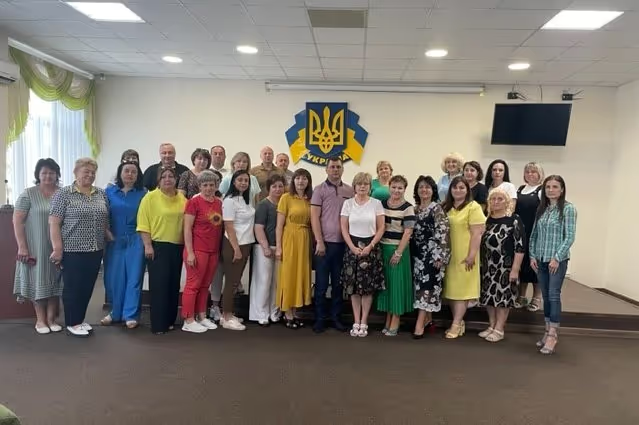
Impressions from Ukraine


Kontakt
Wenden Sie sich gerne an die zuständige Ansprechperson:
Dr. Helga Lukoschat
Senior Advisor at EAF Berlin
.jpg)
Weitere Einträge in unserem Blog

.png)


Subscribe
the EAF Berlin newsletter
Stay up to date

Would you like to actively implement diversity and equal opportunities in your organization?
There is no "off-the-shelf" consulting process. Therefore, all EAF Berlin's offerings are tailor-made and range from a single strategy workshop to a multi-year project. Our clients benefit from EAF Berlin's broad portfolio: