
Women’s rights under pressure – a report from the UN Commission on the Status of Women
The 70th session of the UN Commission on the Status of Women (CSW) took place in New York from March 9 to 13, 2026. This year’s theme was "Access to Justice." Helga Lukoschat, co-founder and senior advisor at EAF Berlin, attended as part of the European delegation for the women’s rights organization Soroptimist International.
Once you have witnessed representatives from nearly every country in the world gather at the United Nations to negotiate women's rights, it quickly becomes clear: the UN Commission on the Status of Women is no ordinary meeting. It is the central global forum for gender equality policy—a place where international standards are set and where the world community’s true commitment to women’s rights is put to the test.
The foundation of this work is built on international agreements such as the UN Convention on the Elimination of All Forms of Discrimination against Women (CEDAW), which sets standards for states to dismantle discrimination and actively advance equality. Together with milestones like the Beijing Declaration and Platform for Action, this framework has enabled significant progress over the past few decades—from better protection against violence and increased participation to legal equality in many areas.
Yet, it has rarely been as palpable as it was during these days at UN headquarters: women’s rights and human rights are under pressure worldwide. And with them, democracy itself.
Despite the impressive conversations and encounters with strong, determined women, I returned home—like most participants, I suspect—feeling concerned and alarmed. While more than 10,000 people used to attend the CSW, this year there were only 4,500. This was primarily due to restrictive U.S. entry requirements. The U.S. played an inglorious role regardless. In a dramatic vote, it was the only country to vote against the "agreed conclusions" on this year’s priority theme. For the first time in UN history, this annual declaration was not adopted by consensus, but by majority vote. The U.S. had submitted eight proposed amendments, a key goal being to strike the term "gender" entirely or replace it with "women and men." The move was defeated, though only by a relatively narrow margin. Consequently, hardly anyone at this year’s CSW was hoping for new momentum or further steps in equality policy—the focus was simply on defending what had already been achieved.
When rights exist but are out of reach
In addition to the deliberations of government delegations with ministers and parliamentarians, hundreds of country-led side events and NGO-led parallel events took place again this year. I focused on the following issues: structural barriers to accessing justice, the role of education as a key lever, the representation of women in parliaments, and the situation in Ukraine with regard to UN Resolution 1325 ("Women, Peace and Security").
One statement served as a recurring theme throughout the conference: formal rights are not enough. At the same time, women worldwide have only about 70 percent of the rights granted to men. The parallel event “Ensuring Women’s Access to Justice and Addressing Structural Barriers” addressed the following questions: What is the use of the right to protection from violence if survivors do not know their rights, cannot afford legal counsel, or are silenced by their environment? What is the use of a law if patriarchal norms, fear, shame, and economic dependence block the path to the courtroom?
A particularly moving account was given by Melissa B. Viquez, a judge from Costa Rica and head of the "Access to Justice" department at the Supreme Court. She demonstrated what an accessible justice system can look like: judges actively reach out to those affected or visit them at home—a system that truly reaches people.
At the same time, she warned that populist-authoritarian parties are gaining ground because many people no longer feel heard and have lost trust in parties, processes, and institutions. When justice, participation, and recognition are lacking, democracy begins to falter.
Andrea Barron from the NGO Torture Abolition and Survivors Support Coalition (TASSC) in the U.S. drew attention to women fleeing wars and conflicts, such as those from Ethiopia or Eritrea, who have very often experienced sexualized violence. She emphasized the importance of speaking not of "victims," but of "survivors." It is a matter of dignity and respect.
The importance of terminology and language was a recurring theme across numerous panels. Nyaradzayi Gumbonzvanda, Deputy Executive Director of UN Women, hit the nail on the head: it makes a difference whether we speak of "child marriage" or the "abuse of children." Children cannot marry.
Education is more than just schooling – it is a path to self-determination
The event took place at the Permanent Mission of Germany to the United Nations “Education for Justice” , hosted by the BMFSFJ and the German Women's Council.
Federal Minister Karin Prien focused her opening remarks on the right of women to live a life free from violence. She pointed to the Violence Support Act, which aims to guarantee comprehensive counseling and protection services by 2032. Combating sexism remains fundamental, she noted, citing the “Alliance against Sexism” coordinated by the EAF. She also emphasized the need to focus more on young men in the future, as they are empirically more likely to lean toward authoritarian positions.
The transition from “legal literacy,” or knowledge of the law, to “legal empowerment,” or the ability to exercise one's own rights, can only succeed, according to Nahla Haidar , Chair of the CEDAW Committee, if local contexts are taken seriously, digital tools are utilized, and prevention, justice, education, and civil society are brought together.
A best-practice example was described by Leonora Tima, founder of the South African NGO GRIT (Gender Rights in Tech). The “Zuzi” platform, developed in collaboration with young people, conveys knowledge about women's and human rights in an accessible and targeted way.
Parity is not a luxury – it is a democratic necessity
According to the latest survey by the Inter-Parliamentary Union (IPU) and UN Women report that the global share of women in parliaments currently stands at 27.5 percent. Only 30 parliaments have a female representation of more than 40 percent. With just under 33 percent, Germany ranks in the middle of the pack. Parliaments play a decisive role in legislation. The presence of women in decision-making bodies is a key factor for successful gender equality and women's policy. The President of the French National Assembly, Yael Braun-Pivet used her country as an example to show what can be achieved: France has had a parity law since 2001; the right to reproductive freedom (abortion) was recently enshrined in the constitution, and the "consent principle"—in the sense of "yes means yes"—was introduced for the crime of rape. The case of Gisèle Pelicot, which has caused massive waves in France and beyond, has also contributed to this.
The anti-feminist backlash is organized and international
I found the event “Countering Backlash and Safeguarding Women’s Rights” organized by the Council of Europe, UN Women, and the OSCE, particularly alarming.
It was stated unequivocally what we are dealing with: not isolated setbacks, but a coordinated, well-funded, international backlash against women's rights and democratic institutions.
Alain Berset, Secretary General of the Council of Europe, spoke clearly on this. The physical and digital violence experienced by 80 to 85 percent of women in public political life is no coincidence, but part of an organized authoritarian strategy. Petra Bayr, President of the Parliamentary Assembly of the Council of Europe, and Member of Parliament Zita Gurmai from Hungary also advocated with great determination for parity and the defense of women's rights: attacks on reproductive self-determination, the Istanbul Convention, or the rights of LGBTIQ individuals should not be viewed in isolation. They are part of an assault on the liberal constitutional state, on plurality, and on social diversity.
So, what can be done to counter anti-feminist groups? Sasa Gavric from the OSCE’s ODIHR institute in Warsaw presented recommendations from an upcoming study by the institute. In addition to empirical research and data collection, Gavric highlighted the need for secure funding for NGOs, national action plans to respond more quickly to disinformation campaigns, and international cooperation and the exchange of best practices. Finally, he recommended better protection of women's rights in national constitutions and, more generally, strengthening cooperation between parliaments and civil society.
Ukraine shows how closely women's rights, justice, and peace are linked
For me, the panels on Ukraine were among the most impressive events. Ukraine is a cause close to my heart, as I had traveled through the country for our project shortly before the Russian attacks began “Together for Democracy” . The side event “Advancing a Just Peace: Justice as its Integral Element and Women’s Participation in Peacebuilding” at the Permanent Representation of Ukraine was particularly moving. The EAF is also a partner in the “Alliance for a gender-responsive reconstruction of Ukraine.”
The message was clear: there can be no just and sustainable peace for Ukraine if the crimes of the Russian army go unpunished. According to the Ukrainian side, 193,000 war crimes cases have been opened to date, and 240,000 crimes have been documented.
Ukraine’s national commissioner for gender equality, Kateryna Levchenko, spoke about the specific barriers to accessing justice. Although Ukraine has signed the Istanbul Convention as well as UN Resolution 1325, which condemns sexualized violence in wars and conflicts, many women lack the means to assert their rights. Furthermore, law enforcement agencies are not adequately equipped.
Kristyna Kit, president of the Ukrainian Women Lawyers Association JurFem, demanded that there be no amnesty for perpetrators and that funds be established for reparations for affected women. Representatives from Finland and Lithuania also signaled their support; Finland, for instance, is providing 3 million euros to UN Women for this purpose.
At the same time, we must keep in mind that women are represented in peace negotiations worldwide by an average of only 7 percent. In 9 out of 10 negotiating teams, there are no women at all.
Women are not just victims. They are active participants, witnesses, and political voices.
At the event “Arbitrary Detentions and Enforced Disappearances of Ukrainian Women Journalists by Russia” at the EU Permanent Representation, people who have experienced imprisonment and torture firsthand spoke, including the journalist Ludmyla Huseinova, the journalist Vladislav Yesypenko as well as the sister of the journalist who remains imprisoned, Olena Rudenko. So far, 900 crimes against journalists have been documented.
Women in Russian captivity have their heads shaved, are malnourished, held in underground prisons, tortured with electric shocks and beatings, and raped. Detention often occurs without official charges, without a trial, and without any contact with the outside world.
Female journalists cannot be released through official prisoner-of-war exchanges because the Geneva Convention only applies to soldiers. At the same time, Russia denies holding any journalists at all. Releases can therefore only be achieved through back-channel negotiations.
I was struck by the dignity with which these experiences were shared. Ludmyla Huseinova has since founded a support group for women who have returned from Russian captivity: “Numo, Sisters!” (“Let’s go, sisters!”) This call to action represents something that became apparent time and again in all the debates at the CSW: women are not just victims of war and violence. They are active participants, witnesses, organizers, and political voices.
And what remains?
First, the realization that women’s rights serve as an early warning system for the state of democracy. Where equality is pushed back, where language is “cleansed,” violence is downplayed, and women’s political participation is restricted, the rule of law, pluralism, and freedom also come under pressure.
The disputes over the language of this year’s conference’s Joint Declaration are therefore much more than a question of style. The intention to erase the term “gender” is linked to the idea of a “natural order of the sexes.” Contrary to all scientific findings, there is no place in this view for other gender identities, such as non-binary people, nor for trans or homosexual individuals. And tied to this binary concept are traditional notions of gender roles and family, and ultimately, male supremacy.
That is why it is so important to stand up against this together. Women’s rights must be resolutely defended—legally, politically, institutionally, and socially. This includes inclusive access to justice. It includes education that enables self-determination. It also includes parity in parliaments and decision-making bodies. It includes the protection of survivors of gender-based violence. And it includes the clear political insight that there can be no democracy without gender justice.
During these days, New York showed me one thing above all: progress is possible. But it remains fragile. And that is precisely why it needs more than just fine words. It needs political will.
Kontakt
Wenden Sie sich gerne an die zuständige Ansprechperson:
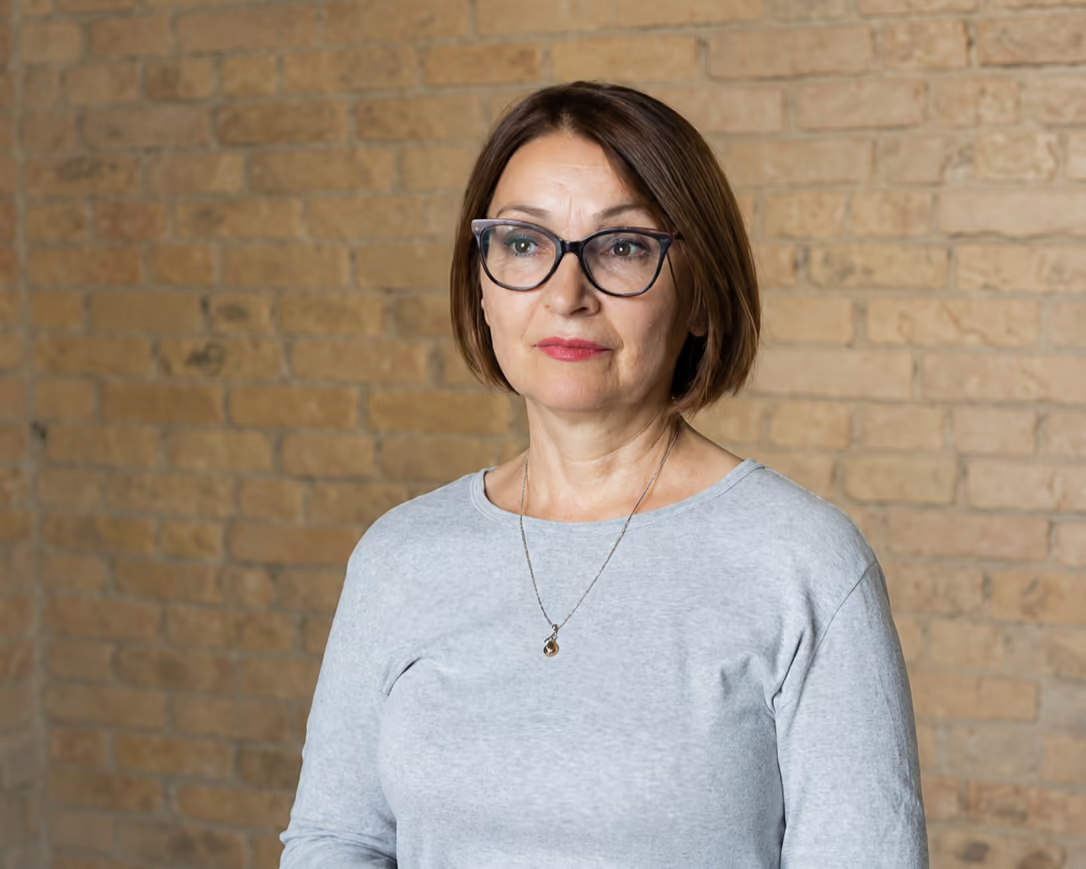
Dr. Helga Lukoschat
Senior Advisor at EAF Berlin
.jpg)
Weitere Einträge in unserem Blog
.avif)


Subscribe
the EAF Berlin newsletter
Stay up to date

Would you like to actively implement diversity and equal opportunities in your organization?
There is no "off-the-shelf" consulting process. Therefore, all EAF Berlin's offerings are tailor-made and range from a single strategy workshop to a multi-year project. Our clients benefit from EAF Berlin's broad portfolio: