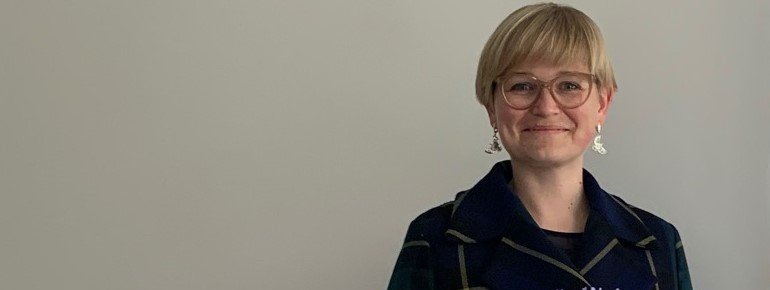
In early March, Foreign Minister Baerbock presented the new guidelines for feminist foreign policy (FFP). You were involved in the consultation process as a civil society expert. What is your assessment of these guidelines?
I consider feminist foreign policy to be important and relevant, and I fundamentally agree with the Foreign Minister when she says: As long as women are not safe, no one is safe. In the countries where I have worked and continue to work, women's rights are the benchmark for the state of society. I also like that she consistently seeks a connection to practice and, not least, that the Federal Foreign Office intends to work on its own structures and strengthen the representation of women. Gender budgeting is a good long-term instrument, even if it is certainly not always easy to apply in development cooperation. On one hand, the guidelines offer a vision; on the other, they include very practical projects, such as addressing war crimes in Ukraine, particularly crimes against women. I think it is good that Annalena Baerbock is committed to ensuring that the perpetrators are prosecuted and punished.
However, what I find missing are concrete answers from a feminist foreign policy to a war like the one Russia is currently waging against Ukraine. This is because it emphasizes non-military, rather pacifist diplomacy. How can it be effective against a dictatorship like Russia, which tramples on human and women's rights? Shouldn't we use feminist foreign policy to conduct much stronger monitoring of states where human and women's rights are disregarded? Shouldn't that be a seismograph for us? Such countries should not be partners for us, not even economic ones. These are countries that can potentially become aggressive in their foreign policy as well. Here, our values-based foreign policy always leads us into a contradiction, and we should at least face up to that. On one hand, we have our little sheltered world, and on the other, we try to ignore what stands in opposition to it or counteract it with small projects, for example by supporting women. That is no solution! Instead, we must honestly discuss what our interests are in the world, and also whether we can set aside economic interests. And if we cannot do that because the economy is more important than our values, then we should be honest about that.
Are you suggesting that we shouldn't hold human rights in such high regard, but rather admit that the economy always takes precedence?
Yes, because that is exactly what happened with Russia. Putin could do whatever he wanted, for example starting the war against Ukraine in 2014, and yet Nord Stream 2 was signed. We must learn lessons from this! For example, by supporting Ukraine much more strongly than we have so far. That would be a feminist foreign policy as I understand it. Because our values are being defended in Ukraine. And if we do not stop this Russia, then many more people will fall victim to it, and Georgia and Moldova are just two examples.
You were recently transferred to Chisinau. Can you draw anything from the guidelines for your new tasks in Moldova?
I can build on the goal of strengthening the representation of women in politics. Equal participation, especially in politics, is a fundamental prerequisite for democratic development, including here in Moldova. We have a good starting point for this: Moldova has a female president, until recently there was also a female prime minister, and the cabinet is filled with many women who are responsible for issues such as security and the interior, among others. Women here are the "agents of change," as they are also mentioned in the Federal Foreign Office's guidelines. They move society forward, are not corrupt; they have a vision for a democratic Moldova. My task here will primarily be to strengthen this political engagement at the local level, naturally with the goal of also promoting the representation of women at higher levels.
Are the female members of the government open to gender equality issues?
They are open-minded, but they don't necessarily promote the topic of equality, because the local society is still quite conservative. However, you can feel that a new generation of women is active here.
Our cooperation project "Together for Democracy" was in many respects lived feminist foreign policy. Can you build on that in your work in Moldova?
Absolutely. I learned in this project myself how one can practically strengthen women in politics. Especially in Eastern European societies, which still present many challenges for women. I also take away the fact that this must be a main task of political education here, not just some side program. Because, as I said, it is often women in these societies who bring about change.
What are your next gender policy projects?
First, I want to meet with the women's organizations of our partner parties to find out what their concerns, needs, and wishes are. Then there are local elections here in the autumn, and we want to see how we can subsequently create a project that directly addresses women. I would also find an exchange between women active in local politics in Ukraine and Moldova interesting. Both have EU candidate status. Both are working on strengthening the regions and the local level. In Ukraine, this has already been implemented; in Moldova, it is still in the process. In both countries, the representation of women at this level is still rather weak. Especially now, when it is also about the reconstruction of Ukraine, I could well imagine an exchange program in the border region.
Kontakt
Wenden Sie sich gerne an die zuständige Ansprechperson:
Dr. Brigitta Triebel
Weitere Einträge in unserem Blog
Subscribe
the EAF Berlin newsletter
Stay up to date

Would you like to actively implement diversity and equal opportunities in your organization?
There is no "off-the-shelf" consulting process. Therefore, all EAF Berlin's offerings are tailor-made and range from a single strategy workshop to a multi-year project. Our clients benefit from EAF Berlin's broad portfolio: