
"The absence of women in politics is a disgrace"

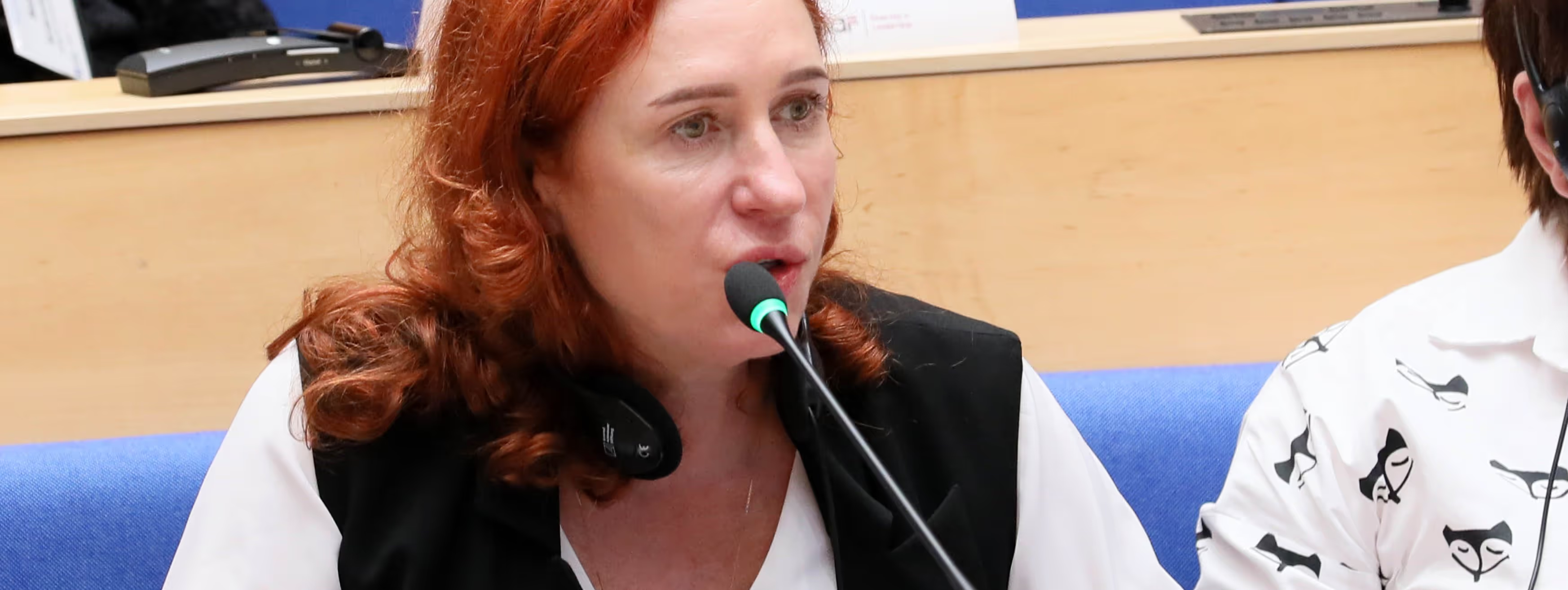
A cultural professional and former mayoral candidate in Odesa, she is the chair of the Ukrainian women's organization Diya.
Natalya, your women's organization, Diya, is involved in national defense in many different ways. What exactly do you do?
Diya has 28 branches across Ukraine. There is a volunteer center in Rivne that helps displaced persons. In Ternopil, we set up a sewing workshop to produce men's underwear, and in Vinnytsia, we weave camouflage nets. Kropyvnytskyi is also involved in refugee aid, as everyone from the Donetsk region is being evacuated there. In occupied Nova Kakhovka, we support a boarding school for children with disabilities. In occupied Kherson, we help families with many children. And all branches that receive humanitarian aid forward it to the occupied cities. Odesa, however, is our organization's headquarters, as that is where Diya was founded. We run a volunteer center for humanitarian aid, and we support displaced persons, boarding schools, hospitals, maternity wards, and, of course, we help the military.
What does this support look like?
At the beginning of the war, when the situation was very difficult, we cooked food, sewed clothes, and raised money for ammunition. We did everything we could. Because we are all fighting together against a heinous enemy. All of Ukraine is like a single organism fighting for its life and its future. Military and civilian energies are like yin and yang; they flow into one another—the front and the rear, the military and the volunteers, military weapons, information warfare, military strategy and tactics, diplomatic strategy and tactics: everything is connected. Every small victory is like a bead on a string that forms a chain called final victory. And I am certain that 50 percent of our victory depends on the support of an active home front.
So, the active home front consists of women's organizations and other civil society groups?
Yes, and they play an important role in wartime. Men usually volunteer for the army and fight in the armed forces. Women take on more humanitarian tasks. Everyone at Diya is a volunteer. Even those who have gone abroad with their children are active on the humanitarian front there, holding rallies and sending us humanitarian aid. But we also have members who have fought in the medical service, and we have a lieutenant colonel in our ranks.
At the "Shoulder to Shoulder" conference, you also talked about how you supported the 18th Marine Battalion stationed in Odesa. How did that come about?
I was called to the battalion's location right at the beginning of the war because the contracts for the logistics companies supplying provisions had to be renegotiated under wartime conditions. Deliveries now had to go to a different address. But the bureaucratic process was taking too long. The war was already in full swing, so we had to get help ourselves. I took my car, my husband was the driver, and my son-in-law was the loader. Diya members gathered the essentials. In war, everything has to happen quickly. It is the volunteers' job to respond to the military's needs as fast as possible. And that is what we do.
Your call sign or nickname is "Mama." How did you get that?
I come from the cultural sector and wasn't familiar with military customs, even though Diya had worked regularly with the marine battalions before the full-scale war. Shortly after the war began, a sentry stopped me and asked for my call sign. I gave him my last name—and he said, "No, that's not a call sign! Are you from Odesa?" I said yes and added, "Odesa-Mama is here," because our city is also called "Mama." That’s how I got my call sign, which the sentry passed on to the battalion. Unfortunately, that comrade died on June 3rd. It is a great loss for me. He was the best soldier I knew, and I miss him dearly. I am now called "Mama" at our volunteer center, too. The refugees come with children, and I look after them when I have time. We do a lot to help the children in Odesa. So, my call sign will be with me for many years to come.
You ran as a candidate for the "Holos" party in the last mayoral election in Odesa. What were your motivations?
I wanted to show other women that politics is neither dirty nor frightening, but rather the place where essential decisions for all of us are made. The absence of women in politics is a disgrace. Yet stereotypes block their path. Even within parties, they are traditionally relegated to the role of a "support group." As candidates, they receive fewer votes; and if they advocate for gender equality with feminist positions, their success is even lower. In the eyes of many voters, they are enemies of men, the family, and tradition. That is why it is easier for women in politics if they maintain strong ties to women's organizations. It is necessary not to act alone in a political vacuum, but to work in connection with other women. My campaign slogan was "Woman for Woman." Because who knows the problems of the community, society, and the country better than a woman? She manages the household, goes shopping, visits the hospital, the school, the kindergarten... she knows all the problems, will draw others' attention to them, and can solve them together with other representatives. But for some reason, women don't vote for women. They say, "While I'm cooking borscht, she's speaking on the podium?" Or, "Politics is a man's job." Such opinions stem from family and upbringing. My daughter will never say anything like that because she has a role model: her mother, who is as strong as a tank. Even though I didn't win, I learned a lot: I was pelted with mud and slandered, and at first, I took it very much to heart. Only when I stopped reading that filth and reacting to it did it subside. The most important lesson I learned is to be brave, not to be afraid, to take responsibility, and to see things through to the end.
Kontakt
Wenden Sie sich gerne an die zuständige Ansprechperson:

Weitere Einträge in unserem Blog
.png)


Subscribe
the EAF Berlin newsletter
Stay up to date

Would you like to actively implement diversity and equal opportunities in your organization?
There is no "off-the-shelf" consulting process. Therefore, all EAF Berlin's offerings are tailor-made and range from a single strategy workshop to a multi-year project. Our clients benefit from EAF Berlin's broad portfolio: