Distribute care work fairly – rethink working hours!
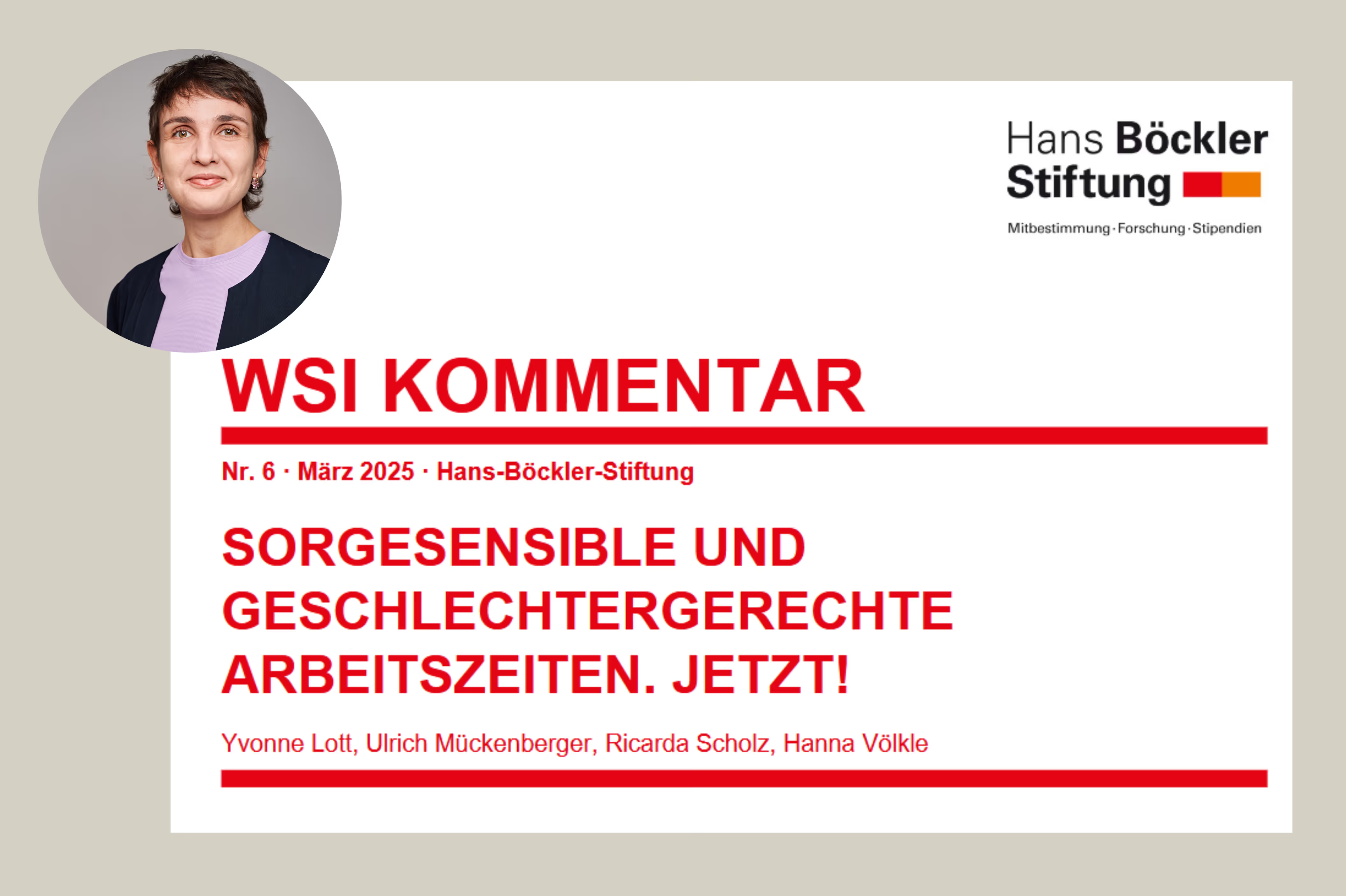
Investing in infrastructure and climate protection is the right path for the Union and the SPD. However, this requires not only funding but also labor and the necessary legal framework. A short analysis by the WSI (Hans-Böckler-Stiftung) by Dr. Yvonne Lott, Prof. Dr. Ulrich Mückenberger, Ricarda Scholz, and Hanna Völkle highlights significant weaknesses in the coalition negotiators' exploratory paper. They argue that the agreement between the Union and the SPD lacks any approach to "redesigning working hours in a care-sensitive and gender-equitable way." On the contrary, the researchers warn that women are likely to suffer the most, and the shortage of skilled workers will likely worsen rather than improve.
For instance, at the initiative of the CDU and CSU, the paper proposes more opportunities for very long working days by shifting the maximum working time limit from a daily to a weekly basis. There are also plans to introduce financial incentives for overtime. The researchers point out that extensive research shows very long working hours are detrimental not only to health but also to gender equality. Gender inequalities in the labor market would be exacerbated. While women—especially mothers of young children—often have no room for longer working hours because they shoulder the lion's share of care work, tax-incentivized overtime would leave men with even less time for their families.
The plans in the exploratory paper place a burden on partnerships and families. They make an equal division of paid and care work more difficult, the researchers note. The planned tax exemption for overtime is likely to benefit full-time employees primarily, while disadvantaging part-time workers, who are predominantly women. This could widen the gender pay gap.
Furthermore, Lott, Mückenberger, Scholz, and Völkle analyze that the measures in the exploratory paper could further weaken democracy. WSI surveys show that many employees already lack the time for political or social engagement. Only a good third of the workforce is as active as they would like to be, and among working mothers, that figure is just 20 percent. A functioning democracy, however, requires citizens who have the time to participate in political and civil society.
Therefore, the Working Hours Act must not be diluted but strengthened, according to Lott, Mückenberger, Scholz, and Völkle. While collective bargaining agreements provide better working conditions, they do not reach all employees. The group of experts recommends four essential measures for modern working time legislation:
- Introduction of ten days of paid leave for fathers and second parents after the birth of a child, as provided for by the relevant EU directive,
- Expansion of the "partner months" in parental allowance (Elterngeld),
- Reform of the Bridge Part-Time Act (Brückenteilzeitgesetz) to make it accessible to more employees,
- Introduction of a tax-funded income replacement benefit for family caregivers.
Furthermore, the researchers advocate for a flexible working hours act, as proposed by the German Women Lawyers Association, or the implementation of an optional time model "that provides for time-based drawing rights not only for childcare, caregiving, and further education, but also for voluntary work."
"If the goal is for women to engage in more paid work—especially in times of skilled labor shortages—measures must be taken to help distribute care work more fairly between the genders. However, the announced measures point in the opposite direction," says Prof. Dr. Bettina Kohlrausch, Scientific Director of the WSI. "They create incentives for men to further increase their working hours, which reduces the time available for a more equitable distribution of care work."
Download
Read the commentary here: https://www.wsi.de/fpdf/HBS-009096/p_wsi_kommentar_6_2025.pdf
More information
The commentary "Care-sensitive and gender-equitable working hours. Now!" was written by authors Yvonne Lott, Ulrich Mückenberger, Ricarda Scholz, Hanna Völkle (EAF Berlin) and published by the Institute of Economic and Social Research (WSI) of the Hans-Böckler-Stiftung.