Now is our time
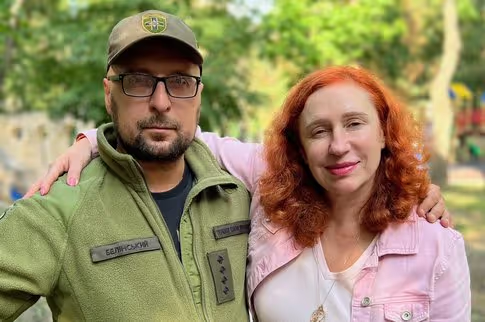
Since the Russian war of aggression began, Ukrainian women's organizations have transformed into humanitarian hubs, addressing the most urgent needs of the population. One example is "Diya."
Our partner Natalya Deliyeva writes: My NGO "Diya" (Women's Association of Ukraine) set up one such center in the heart of Odessa. There, we help displaced persons, large families, single women, and mothers. Every day, people arrive who have fled their cities and communities to escape the Russian occupiers and have lost their homes. They usually arrive with their children because kindergartens are closed and they have no one to leave them with. Once, a young couple arrived who had fled from the Kherson region. Their infant was wrapped only in a towel. I asked them why. "We washed the diapers and clothes and are waiting for them to dry," they explained. They had to leave in such a rush that they could take almost nothing with them. That brought me to tears. Another family came to our center having adopted a young boy who had been left at the maternity clinic at the start of the war. The new parents asked for help because they weren't prepared for an adoption.
Help for everyone
We see stories like this every day. More than 30 families come to our center daily, allowing us to support around a thousand families a month. The most important thing for us is not to turn anyone away, but to help everyone. Our association, "Diya," operates across the country, with each branch having its own focus: helping displaced persons, supporting the military, providing psychological care, organizing relief supplies, and working on the cultural and information fronts. We have international branches in Belgium, Germany, Poland, the Czech Republic, and Slovenia. In Poland, "Diya" helps refugees resettle, while in Germany, they collect relief supplies and money for us. Our women in Antwerp organized a "solidarity dinner," treating their guests to Ukrainian specialties in exchange for donations. We are very grateful for the money transferred. We used it to buy special baby food—for premature babies, for babies with allergies, and gluten-free options—as well as size 5 and 6 diapers, which are in high demand but currently scarce.
Naturally, we also support our military. We raise money to buy medicine, hygiene products, warm clothing, mats, and sleeping bags for the soldiers.
We also help hospitals. Recently, medical supplies and medication were delivered to the women's ward of the psychiatric hospital. It is overcrowded with locals and internally displaced persons. For the first time, female soldiers are among the patients. Often, people cannot mentally withstand the tragedy of the war. They don't understand what is happening to them, they despair at the suffering, and they fall into depression and long-term mental illness.
We even help animals by delivering food for dogs and cats to the conflict zones. The population has been evacuated, but not everyone could take their pets with them. As a result, there are many homeless animals in the abandoned regions. We help and care for everyone who asks us for support.
If we are not compassionate toward one another, if we do not help each other, and if we do not reach out to those in need, then the war will not end in victory. We can only endure all the destruction, fear, and loss of war if there are people around us who support us morally and materially.
Providing hope
This is the time for women. Many Ukrainian women come to us because they no longer have a home, and some have nowhere else to go. They have such sad eyes; their souls are weeping. When you give them food, they take it as a matter of course. But when you give them face cream, a bedsheet, or slippers, they start to cry or have an outburst. Perhaps we shouldn't give them such "homely" things, but they have nothing... Today, a young woman from Chornobayivka in the Kherson region, where heavy fighting is taking place, burst into tears when I gave her a new warm jacket. She said, "I won't be home for the winter." Perhaps I should ask a psychologist for advice. It isn't easy to provide humanitarian aid. You aren't just giving people something material; you have to listen to them, support them, and give them hope for a good, peaceful future. The women on the home front are bearing the full burden of the war. We help where we can. We women are taking charge.
Natalya Deliyeva is the chairwoman of the Ukrainian women's association "Diya," which was founded in Odessa in 2016. In Newsletter 6 we interviewed her about her political activities and the role of civil society during the war.