An unimaginable nightmare
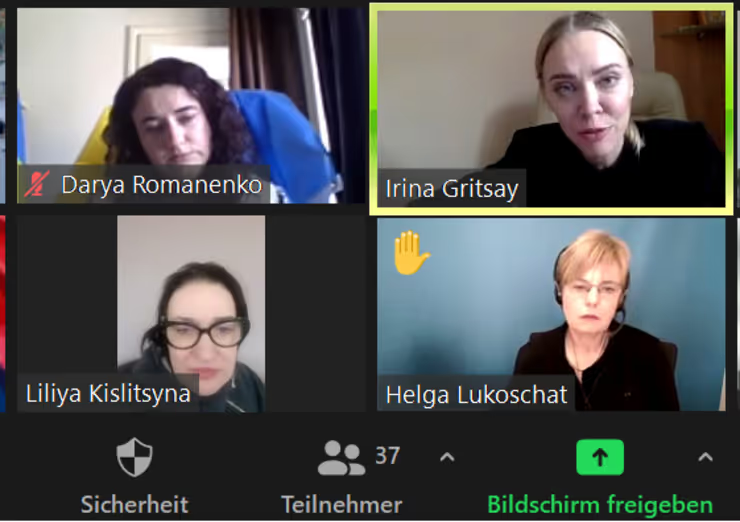
The EAF has organized several video conferences with its Ukrainian project partners to provide information about the situation on the ground, give a voice to the partners' political demands, and discuss opportunities for practical support.
Russia's war against Ukraine has brought the recently launched "Together for Democracy" project to an abrupt halt. EAF Berlin and the Konrad-Adenauer-Stiftung had only just begun their collaboration with local female politicians and women's organizations in eastern Ukraine. The project's goal was to network women in local politics in the eastern Ukrainian regions and increase their representation. Now, it has become an emergency program with the goal of supporting partners in the war zone from Germany as effectively as possible. To this end, a moving initial online exchange took place on March 11 between four Ukrainian partners and around 30 German participants, including local politicians from the EAF's Helene Weber Network, EAF corporate partners, and representatives of other women's organizations.
"We are dying and have to keep rising again"
First, Yuliya Siedaia, a sociologist and head of a "Women in Leadership" project who had fled to Lviv in western Ukraine, reported on the situation in her besieged hometown of Kharkiv. She spoke about the targeted Russian attacks on civilian targets and the entire infrastructure, and the use of cluster and vacuum bombs, which are prohibited by the UN Convention on Certain Conventional Weapons. She emphasized the population's strong will to defend itself, but also shared her fear for family members who remained in Kharkiv: "We die with them every day, yet we have to keep rising again. We are living in an unimaginable nightmare."
In the western city of Lviv, the situation is still relatively calm. Nevertheless, there are constant alarms and, to the south, the first air raids—a dangerous sign that the war could spread to the entire country. "Help us close the airspace over Ukraine," was Yuliya Siedaia's urgent political plea, which was repeated several times by her compatriots. A second demand concerned the opening and monitoring of escape and supply routes to evacuate people from the besieged and destroyed cities and to deliver goods there.
"Many are leaving without a plan or destination"
Liliya Kislitsyna also reported from Lviv, a stopover for countless refugees seeking a way across the border to the west. The former member of the Kramatorsk City Council and head of a women's rights organization described the complex logistics required on the ground to transport and distribute urgently needed aid supplies to the war zones according to demand. She and her fellow citizens are also deeply concerned about the fleeing women and children. "Many are leaving for the West without a plan or destination," unaware of the dangers lurking for them and their children along the way.
"We want to scream so the whole world hears us"
Lawyer and university lecturer Irina Grytsai, formerly a department head in the regional administration of the central-eastern city of Dnipro, joined from there. Dnipro, also a hub for internally displaced persons, has already come under fire. "We wake up to rocket fire, our blood runs cold, fear paralyzes you, but then you think of the children first and have to act. We want to scream so the whole world hears us," said Irina Grytsai.
"People are fleeing the war, not the German welfare state"
Darya Romanenko, born in Kharkiv and raised in Germany, was until recently the head of an NGO in Sloviansk. She reported on her life-threatening escape with her father and grandmother from Kharkiv to Romania. She spoke about the great willingness of the Romanian people to help, but also about the fear and panic among those fleeing. She is currently involved in refugee aid in the Romanian border region and in the reception and accommodation of refugees in her hometown of Kehl am Rhein. She vividly described the logistical problems and bureaucratic hurdles facing those arriving. Many are heading into the unknown, without knowledge of the country they are entering, without language skills, without money, exhausted and traumatized. In the collective shelters, there are no contact persons, only security guards. "These people are coming because of the war, not because of the welfare state," said Darya Romanenko, criticizing how ill-prepared the authorities are for the refugees' situation. She urgently called for the removal of bureaucratic barriers and more flexibility from municipal and regional administrations.
Help: immediate and as unbureaucratic as possible
Several German participants discussed the problems with registering and accommodating refugees in municipalities. Christine Klein, Mayor of Bensheim, provided information on central registration and subsequent distribution according to the Königstein Key in the state of Hesse. She noted that municipalities have little room for quick, unbureaucratic help, citing a lack of housing in her district. Ursula Sautter, Deputy Chair of UN Women Germany and honorary mayor of Bonn, emphasized the need for immediate aid, but also mentioned that Bonn already has an overcrowding rate of 140% for refugees—a situation shared by many other municipalities. She reiterated key demands that women's rights organizations have been making since the major refugee movement in 2015: no accommodation of women and children in mixed-gender collective shelters, violence protection programs for refugee women, and a refugee policy focused on women and children.
Elke Heitmüller also addressed the issue of protection against violence. The head of the "Diversity" department at VW described her impressions from a visit to Berlin Central Station. The current central arrival point for refugees has come under scrutiny because men have been specifically approaching young women there and offering them accommodation. On-site, police and aid organizations are warning of sexual exploitation.
There was consensus that women's organizations must work together more strongly to support refugees and that extensive, immediate financial aid for Ukraine is indispensable. Donations should go to organizations that work either in the war zone itself or in close partnership with people there, and for which the Ukrainian EAF partners can vouch.
In addition to humanitarian aid, Helga Lukoschat, Chair of the EAF Board, emphasized the importance of political support work. This includes educating people about the history of Ukraine and informing them about its civil society and its commitment to democracy, freedom, and equality. "We have great respect for your courage and your commitment, and we will stand by you wherever we can," said Helga Lukoschat in closing.