"We are all united by this cause: getting more women into local politics and parliaments."

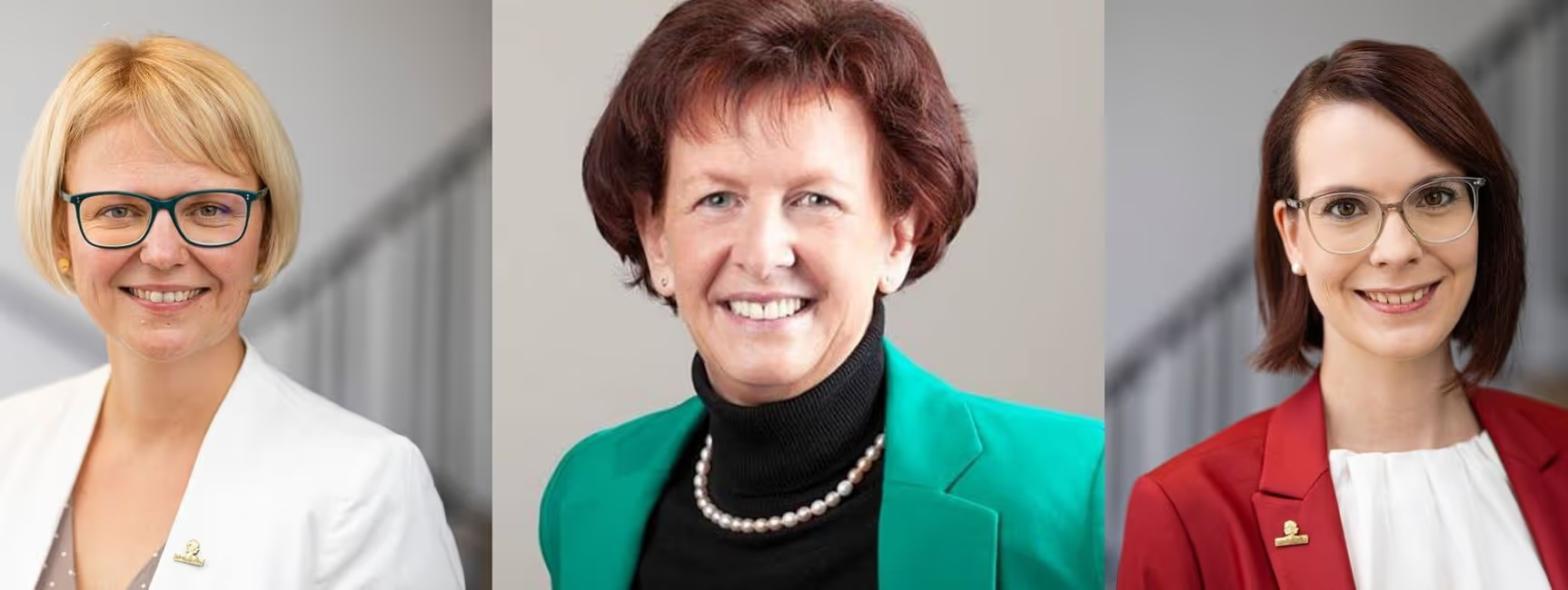
The Helene Weber Network is an association of local politicians who have been awarded the Helene Weber Prize. The spokeswomen are Katja Glybowskaja, Annkathrin Wulff, and Notburga Kunert.
Congratulations on your successful election as spokeswomen! You have all received the Helene Weber Prize yourselves. What has this network meant to you since then?
Kunert: I have been involved from the very beginning, and I find the network that has developed since then to be an absolute enrichment. It is a fantastic group of award winners, and the exchange with other women during our meetings is incredibly valuable and inspiring. Party affiliation plays absolutely no role here. I truly leave every meeting feeling empowered. But the prize is not just an award; it is a mission to work toward getting significantly more women into local politics. The prize and the network make you more self-confident. You know what you are working for.
Glybowskaja: I came to the network more by chance—I hadn't heard of the prize before, and I was, of course, very happy when I was nominated. At that moment, I didn't even realize what a vast network was behind it. Discovering that was fascinating from the start and, indeed, very empowering. It quickly became clear that we all face similar issues and challenges in our work and that we all understand what the old structures mean for us women. Helping more women find the courage to enter politics, while also making it easier for them to do so—that is a very important goal for me.
Wulff: Yes, that goal unites us all: getting more women into local politics and parliaments. I actually hadn't heard of the prize either, and I now experience the group of award winners just as my colleagues do: as a wonderful network from which I have personally gained many ideas for my own work. We strengthen and support one another. I have enjoyed local politics even more since becoming part of the network.
Across all party lines: What experiences and problems do you share as women in local politics?
Glybowskaja: First, there are the framework conditions of political work. The question of which positions are even made available to women, how candidate lists are created before elections, how positions in parties and parliamentary groups are assigned, or how committees are staffed. This often comes down to time management. When do meetings take place, and where are decisions really made—in parliament, or later over a beer? Furthermore, these structures directly affect the content level when it comes to which topics are even placed on the agenda and addressed in politics. Certain topics in education, social affairs, and security often do not get the necessary space in city parliaments or committees simply because they affect women more frequently and women are underrepresented in politics. The third level concerns the culture of communication and self-presentation. For example, how can I assert myself in discussions, and how am I listened to?
Kunert: Women generally have a different perspective, a different angle, if only because of their experiences in childcare and caregiving. Bringing that into local parliaments is sometimes not so easy because there are fewer women there. The network gives us the opportunity to exchange ideas and ask each other: How did you manage that, or how do you sell that to your male colleagues? That is very rewarding, and you often learn that there were already decisions or proposals elsewhere that you could introduce into your own parliament and local work.
Wulff: Whether women are on committees really plays a major role in politics itself. I experienced this in Pforzheim. When I was elected as a city councilor there, I really wanted to be on the Committee for Economy and Digitalization, which I had to fight hard for. At first, I was the only woman on that committee and, for a long time, the only voice that would occasionally ask what was being done to support female entrepreneurs or what the effects of seemingly positive decisions might be for women—for example, whether they feel more uncomfortable at night in an automated bus without a driver. Such topics were not even considered by the male colleagues, which makes it all the more important that women are represented to a greater extent than they are now.
As new spokeswomen, you are now starting your work. What are your goals—what do you want to build on, and what do you want to approach in a new way?
Wulff: For us, it is very clear: we must make this wonderful prize even better known and show what it stands for. Specifically, this means we want to push forward with public relations to reach more people. For example, we are planning to introduce the award winners via profiles on Instagram and Facebook. We also want to revise the homepage so that outsiders can find what they are looking for even faster, for example, if they are searching for an expert on a specific topic. We definitely want to continue the digital formats that have proven successful since COVID, such as the Lunch Talk. And as for in-person events, these should take place in the future not only in Berlin but also in the rest of the country to achieve broader awareness.
Glybowskaja: With all our ideas, we naturally want to build on the many successes of our predecessors. The core remains the network meetings and the exchange among ourselves, supplemented by high-quality input from speakers, for example on topics like rhetoric or social media. In the future, we would like to open some of these formats to women who are not yet award winners but are interested in local politics.
In addition, we want to network the individual competencies of the individual award winners even more strongly. Each of us brings an enormous amount of knowledge and experience, as well as a large personal network. We can all benefit from that.
Kunert: In the coming years, we also want to look beyond our own horizons and beyond Germany. We have already experienced an exciting exchange with France, with Tunisia, and now with women in Ukraine... Continuing and strengthening this dialogue and considering what we can learn from one another is also an important sign for peace.
To be a bit provocative: Is a network just for women even necessary today?
Glybowskaja: Yes, definitely. At least until we reach 50 percent.
Kunert: Yes, it is actually necessary. Unfortunately, not everything necessarily moves forward; there can be setbacks at any time. We have seen that very clearly: before there was a quota in the business world, not much happened. There are still so many issues: equal pay, the allocation of mandates, or the design of structures... There is still a lot to do, and unfortunately, voluntary measures don't get us very far. That is why I believe that women must continue to fight to be heard and represented equally. That is what the prize says, too. Back then, Helene Weber and her colleagues fought successfully for equality in the Basic Law, and if they hadn't done that, it wouldn't be there. Besides, men have their networks, too. That is why we should have ours.
Wulff: I can only agree with that.
If you had one wish: What should have been achieved in ten years through and with the network?
Kunert: Getting more women into politics. That is our primary goal and our motivation. This also includes further networking and helping to ensure that individual municipalities and our country as a whole continue to develop.
Glybowskaja: In ten years, our network may have grown to nearly 100 women, giving us multipliers who can operate from the federal level down to the smallest municipality and serve as points of contact for all women who want to get involved.
Wulff: Absolutely. If we continue the excellent work that has been done in recent years and open it up even further to reach a wider audience, our clear vision is that no one will be able to ignore this network or fail to consult it when it comes to our issues. There is so much expertise and competence here. That is what the network should be in ten years: a network that is seen, appreciated, and respected.
Further information
You can find more about the Helene Weber College and network here.
Kontakt
Wenden Sie sich gerne an die zuständige Ansprechperson:

Weitere Einträge in unserem Blog

.png)


Subscribe
the EAF Berlin newsletter
Stay up to date

Would you like to actively implement diversity and equal opportunities in your organization?
There is no "off-the-shelf" consulting process. Therefore, all EAF Berlin's offerings are tailor-made and range from a single strategy workshop to a multi-year project. Our clients benefit from EAF Berlin's broad portfolio: