No Marshall Plan without women
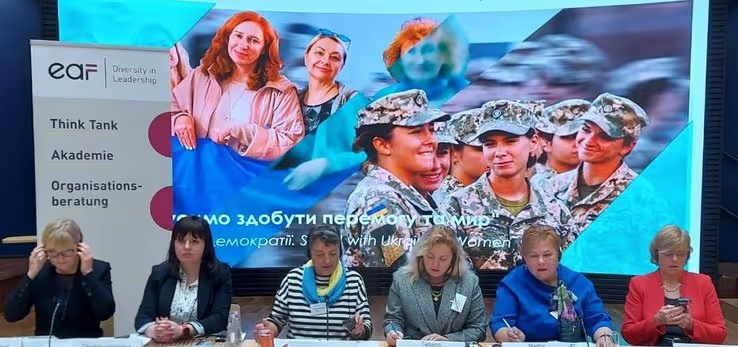
Learning from the women of Ukraine: In the defense of their country against Russian aggressors, Ukrainian women are playing an active and often prominent role on many fronts. At a press briefing, three of them shared insights into the conditions of life and survival during the war: "We are also fighting so that you, too, are not one day woken up by explosions."
The delegation of Ukrainian female leaders is visiting at the invitation of the Konrad-Adenauer-Stiftung, which, in cooperation with EAF Berlin, has been running the project since October 2021 with partners from Eastern Ukraine. Together for Democracy The guests from various regions of Eastern and Southern Ukraine include female leaders from local government, academia, and civil society. During their visit to Berlin and Dresden, they are meeting with political decision-makers and social influencers to share information about the conditions of life and survival during the war, the diverse ways in which women are involved in defending the country, and the impact of the situation on gender equality. They are speaking about their experiences on the ground and what they believe Ukraine most urgently needs in terms of support and future partnerships for reconstruction.
At a press briefing on November 1, Brigitta Triebel, head of the Konrad-Adenauer-Stiftung office in Kharkiv, reported on how the "Together for Democracy" project came to be. She spoke about her encounters and experiences with women active in local politics in Eastern Ukraine, whom she had met through her work. This led to the desire to strengthen their commitment through exchange, networking, and further training. "Our goal is to build democracy together at the local and regional level," said Brigitta Triebel.
"We need your hearts so that we can feel we are not alone"
Nadiia Kolenchenko, a member of the regional council of Kirovohrad, a district in the center of the country, and regional representative of the "Ukrainian Women's Congress" platform, emphasized the importance and necessity of town twinning and expressed a concrete desire to find a German partner municipality for her community. "We need medicine and other relief supplies, but even more, we need your hearts, your emotional and psychological support, so that we can feel that we are not alone."
"We are also fighting so that you, too, are not one day woken up by explosions"
Oksana Yelchiieva is the director of the Department for Social Protection of the Population in the Mykolaiv regional military administration, located in the border area near occupied Kherson, and is therefore constantly on the front line. She described what it is like when an administration has to switch from peacetime to wartime mode. It started when she arrived at work a little late a few days after the Russian war of aggression began, only to find a huge hole in the building where her office had been—caused by a Russian missile. Colleagues in neighboring offices had been killed or injured. "One morning, you aren't woken up by an alarm clock, but by an explosion. That is how the war begins. You get used to it because you are responsible for the population. People need you; their fate depends on you," commented Oksana Yelchiieva, showing photos of the massive and ongoing devastation in her region, the destroyed infrastructure, and the dead in the streets. She spoke about the particular challenge of her work: having to provide for the thousands of internally displaced persons alongside the remaining local population—about 50 percent have left the region. The coming winter poses an additional threat. Houses and emergency shelters need to be heated, but many must be repaired first. Her region is in a state of permanent reconstruction. Yet everything repaired today could be reduced to rubble and ash tomorrow. "And the longer the war lasts, the more support we need, because our public coffers are becoming increasingly empty." Oksana Yelchiieva made an urgent appeal to Germany not to let up on humanitarian and military aid. "Please do not leave Ukraine alone. We are also fighting so that you, too, are not one day woken up by explosions."
"The Russian aggressor has achieved the opposite of what it intended"
The third Ukrainian participant to speak was Tetiana Yehorova-Lutsenko, chair of the regional council of Kharkiv, Ukraine's second-largest city, located on the border with Russian-occupied territories. She reported that she had been elected to this leadership position by a large majority as the first woman. "I have almost forgotten that I am a woman. My people see me as a leader, and I have no right to show even the slightest fear in my eyes, only strength." Since the liberation of the region by the Ukrainian army, life has returned to Kharkiv, even though there are still daily missile attacks. She has since put away her uniform and returned to wearing a suit. She firmly believes in her country's victory, because the Ukrainian people are more united than ever due to the war; never have differences been set aside more, and never has freedom and independence been valued more highly. "So the Russian aggressor has achieved the opposite of what it intended," said Tetiana Yehorova-Lutsenko. She also emphasized the importance of partnerships, referring in particular to an exchange between Ukrainian doctors and Charité Berlin, which had been explored the previous day in a discussion with the Charité's central women's and equal opportunities officer.
Learning from the women of Ukraine
Helga Lukoschat, Chair of the Board of EAF Berlin, concluded by thanking all project partners. From the very beginning, she said, she had been impressed and fascinated by how much women in Ukraine were achieving on literally every front. "We can learn a great deal from women's organizations in Ukraine: resilience, perseverance, and commitment to democracy. In the reconstruction of the country, female civil society will play a prominent role. And the money must reach where it is needed most for them. Therefore: no Marshall Plan without the equal participation and involvement of women!" said Helga Lukoschat.