"I remain convinced that we need more military support"
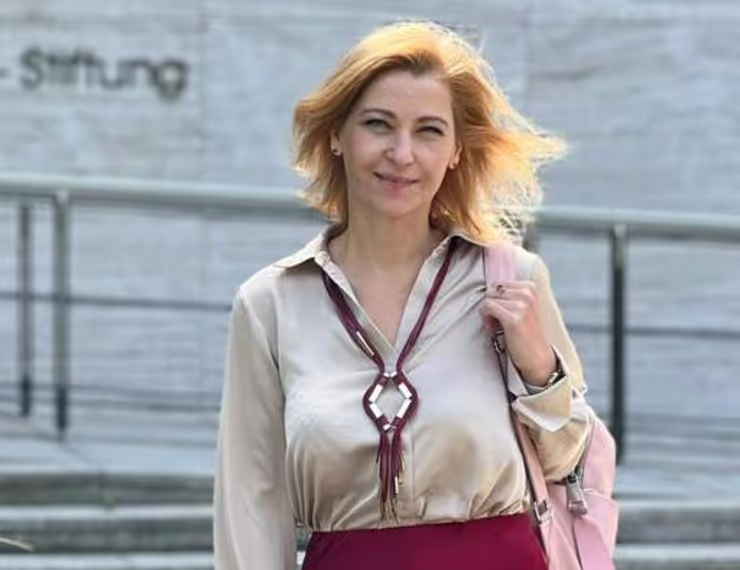
From June to December, she worked at EAF as a Konrad Adenauer Foundation fellow. Now, Yuliia Siedaia is returning to her hometown of Kharkiv.
Yuliia, you arrived in Berlin from Kharkiv in June 2022, right in the middle of the war. What was that like for you?
I had just made a very difficult decision. I was leaving my entire family, friends, and colleagues behind in the war. But I also realized that my temporary stay in Germany would be an opportunity to help my country and my family.
In what way?
I was able to help organize support for Ukraine and its people. For example, I participated in the "Scientists at Risk" project, which provided financial support to 16 researchers from the Kharkiv region. Through the "Together for Democracy" project, we helped the University of Dnipro purchase beds for internally displaced persons who had been taken in by the university. We helped procure essential supplies for the people in the Donetsk region. Visits from female leaders in politics and administration from eastern and southern Ukraine led to new contacts and further support for local communities. A project between the Charité University Hospital in Berlin and the Kharkiv Regional Hospital is planned for the future. At the same time, I made it my mission to raise awareness about what has been happening in the Kharkiv region since the Russian war of aggression began.
The numerous contacts you made in German politics, civil society, and academia provided plenty of opportunities for that.
Indeed, in many conversations, discussions, and conferences, I fought a kind of information battle to spread the truth about Ukraine and its fight for independence.
What are you taking away from this exchange?
It is encouraging that during my time in Germany, not only has the opinion of the German public shifted in favor of Ukraine, but so has that of top German politicians. I am referring to Chancellor Olaf Scholz's statements on supporting Ukraine, but I am especially grateful to Foreign Minister Annalena Baerbock for her strong and unwavering stance on supporting Ukraine, as well as to many other members of the Bundestag and the European Parliament for their invaluable help. I would also like to recall that on November 30, 2022, the German Bundestag passed a resolution recognizing the Holodomor as a genocide against the Ukrainian people. This makes Germany the 19th country in the world to have taken such a decision.
During your stay, you also conducted a study on women in the Ukrainian armed forces. What can you tell us about that?
The results are about to be published, and I don't want to get ahead of myself. Just this much: I was able to carry out this work with financial support from the Konrad Adenauer Foundation, which, among other things, allowed me to purchase warm undergarments for women serving on the front lines.
Has your perspective on the war situation in Ukraine changed as a result of your work and your time in Berlin?
No. I remain convinced that we need more military support; political support alone is not enough. At the same time, I see how sincerely German society supports Ukraine and its people—both those staying here in Germany and those living in Ukraine under wartime conditions. At the same time, I hope that despite these incredibly difficult times, Ukrainians will take more responsibility for what they expect from international partners.
You are returning to your family in Kharkiv. With what feelings and thoughts are you leaving Berlin and EAF?
With incredible gratitude. In general, I would like to dispel some myths about Germany and German society. Germans are honest and open-hearted people who are genuinely willing to help. They respect personal boundaries and are well-mannered, even if they are quite bureaucratic. While I primarily moved among people of my own cultural and educational level—where our value systems and worldviews aligned—I felt respect even in the institutions where I had to obtain various documents, such as the immigration office, the district office, or the bank.
From the very first minute of my stay, my colleagues took me under their wing—sincerely and kindly: especially Helga Lukoschat, but also all the other EAF staff. The entire office had prepared for my arrival. I felt their protection and support every day; I never felt lonely or lost. I would also like to specifically mention Brigitta Triebel, the head of the Konrad Adenauer Foundation's Kharkiv office. Her highly professional understanding of Eastern European politics, and our dialogues and discussions in Kharkiv, were what ultimately prompted me to come to Germany. There, I achieved a great deal in a very short time and built up professional social capital almost from scratch. So, I look forward to our continued cooperation.
Winter in Ukraine is harsh, and we hear daily reports of new attacks everywhere on critical infrastructure. What awaits you upon your return to Kharkiv?
Due to constant Russian shelling, the Kharkiv region, like the rest of Ukraine, frequently faces power, water, and communication outages. Although local authorities are working tirelessly, they often cannot keep up. I am bringing many supplies, such as candles, batteries, and power banks, which will help my loved ones survive this terrible winter. However, the joy of reuniting with my family and the hope for victory give me confidence and resilience, even in the face of this horrific war.
Yuliia Siedaia is a partner in the "Together for Democracy" project. A social scientist with a PhD, she served as a consultant in the Kharkiv administrative district, focusing on gender equality and health, and was also active in the "Academia of Women Leadership." From June to December 2022, she was a fellow at EAF Berlin, supported by the Konrad-Adenauer-Stiftung (KAS). Among other projects, she conducted a study on women in the Ukrainian Armed Forces, examining legal progress in equality as well as gender-specific stereotypes within the male-dominated military culture.