"The Ukrainian issue must not disappear from the German agenda"
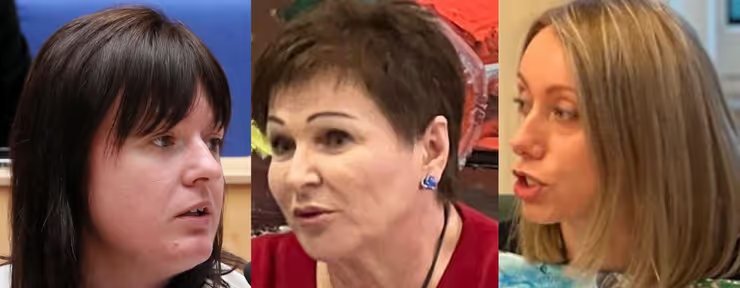
Lyudmila Prokopechko from the Odessa region, Yuliia Kostiunina from the Donetsk region, and Oksana Yelchiieva from Mykolaiv visited Berlin and Dresden as part of the "Together for Democracy" delegation. We asked them about the challenges their leadership roles entail under wartime conditions.
They also shared their expectations before visiting Germany, the mission they set out with, and the experiences and insights they brought back to their cities and communities. Here are their answers:
What are the biggest challenges you are currently facing?
Lyudmila Prokopechko: When the Russian invasion began, I faced challenges I had never experienced before: as a civilian, I had to deal with conscription and the establishment of checkpoints, organize local self-defense, and provide shelter. I had to receive, house, and feed soldiers and refugees, as well as set up warehouses for humanitarian aid. I had to seek out and build cooperation with domestic and foreign organizations and foundations, and coordinate volunteer work. Most importantly, however, I had to ensure the continuous operation of all infrastructure, utilities, and social services—all under the extremely difficult conditions of martial law.
The cold season has already begun, and the enemy is dealing devastating blows to our vital infrastructure. This makes the issue of winter preparation very urgent. This primarily means: protecting energy and water supply systems, installing alternative power sources, mobile boilers, and water purification systems, setting up stationary and mobile warming centers, providing shelter for displaced persons from occupied territories, and supplying fuel, medicine, and food to the most vulnerable population groups.
This work requires great effort, the highest level of concentration and cohesion, a quick response and adaptability to new circumstances, and, of course, the moral and material support of the international community.
Yuliia Kostiunina: I oversee the social and humanitarian sector, which always requires special attention. But Russia's armed aggression against my country has led to new challenges: evacuating the population to safer regions and evacuating social institutions that house the elderly, people with disabilities, and orphans. We have evacuated more than 5,000 people from these categories from the region. In addition, there are large families, foster families, family welfare institutions, and others. We learned from the bitter experience of 2014, when institutions, organizations, and educational facilities started from scratch, and we tried to evacuate cultural and material assets and equipment.
Another task is supporting our residents in the regions to which they have fled or relocated. The Donetsk region has already set up 37 such support centers in various regions. It is also very important to organize life support for citizens from the annexed territories. They receive a comprehensive range of services, from social benefits and the provision of housing for those who have lost it, to organizing the educational process for children.
Oksana Yelchiieva: Around 50 percent of the Mykolaiv region is currently contested, occupied, or under siege. Under these conditions, we must provide the residents with as much social support as possible. State and regional programs include, among other things, state social assistance for families with children, low-income families, persons disabled since childhood, subsidies for caring for a disabled person, reimbursement for the "City Nanny" service, support for a person caring for a sick child, subsidies for children growing up in large families, state social benefits for orphans and children without parental care, and financial support for foster and adoptive parents for providing social services in family-type children's homes and foster families. Subsidies are granted for rent, the purchase of solid fuels and liquefied gas, and for other municipal services.
In addition, a humanitarian aid headquarters was established at the Mykolaiv Regional Military Administration for the duration of martial law. This center coordinates the activities of local military administrations, local self-government bodies, law enforcement agencies, institutions, companies, organizations of various forms of ownership, NGOs, and volunteers in organizing the receipt, provision, registration, and distribution of humanitarian aid.
To meet the humanitarian needs of the population in the Mykolaiv region, humanitarian headquarters were set up in every district military administration. Relief supplies (food, hygiene products, clothing, and other essential goods) are made available to local authorities upon their request and are calculated based on the current population and the number of internally displaced persons. Humanitarian aid is provided primarily to the most socially vulnerable groups—low-income and large families, people with disabilities, the elderly, and internally displaced persons. Currently, over 204,000 people are registered nationwide who left the Mykolaiv region after February 24, and 110,000 internally displaced persons are registered in the region. They, too, must be supported and provided for. Over 16,000 places are available in emergency shelters. For internally displaced persons with disabilities and elderly people living alone, about 1,200 additional places are available. As part of the "Shelter" program, almost 19,000 homeowners provided accommodation to around 55,000 internally displaced persons. They received compensation from the state for this.
Another challenge is supporting people with limited mobility and ensuring the functioning of stationary social protection facilities, especially geriatric and psychoneurological institutions. The department I lead operates ten stationary facilities, including two geriatric, seven psychoneurological, and one for children with disabilities. As of November 1, 2022, 1,254 people were living in these facilities, including 201 internally displaced persons.
I would also like to specifically mention the evacuation of the Stepivsky orphanage in Odessa. In March 2022, at the invitation of the Christian Youth Village Association of Germany, 36 children were able to travel to Germany accompanied by the acting director of the orphanage. Most have complex illnesses and developmental disorders. On March 23, they were flown from Poland to Bonn/Cologne on Polish government and transport aircraft, a joint initiative of the First Lady of Poland, Agata Kornhauser-Duda, and the First Lady of Germany, Elke Büdenbender. On July 7, both First Ladies visited these children together and familiarized themselves with the conditions of their stay at the Christian Youth Recovery Center. We thank Elke Büdenbender for providing humanitarian aid to Ukraine in the field of child protection.
At the moment, however, the most important challenge is coping with the coming winter. 300 warming centers have been set up in the region. All are equipped with first-aid kits and fire extinguishers, as well as food and warm clothing. In addition, there are facilities for the homeless in the region. Currently, community leaders are working to supply these facilities with firewood and stoves, warm winter clothing, and food.
At the same time, there is an urgent need for generators, alternative power sources, and support in setting up sleeping areas with folding beds, bedding, blankets, mattresses, and pillows, as well as areas for the quick preparation of hot drinks and meals.
What were your expectations for the trip? Did you come with a specific mandate or mission?
Lyudmila Prokopechko: My main goal was to convey the truth about the war in Ukraine to the German politicians and public figures we met, so that the Ukrainian issue does not disappear from the German agenda. I wanted German society to understand that Ukraine is fighting today not only for its own freedom, but for the freedom of all of Europe, for democracy and European values, and for the right of every nation to live freely in its own country. Another task was to draw attention to how we can survive the difficult autumn and winter period.
Yuliia Kostiunina: I actually wanted to participate in discussions and report on how the Donetsk region lives and works today, and the role women play in democratic transformation. But even during the first meetings and discussions, I felt that I had to speak about what is happening in my country and my region and convey the horrific reality to the participants: 138 children from the Donetsk region will never grow up, and 241 children have been physically maimed. More than a million people have been forced to leave their homes. Hundreds of thousands are living under occupation. Russia is deliberately destroying cities and villages. Especially in the occupied territories, the Ukrainian language, literature, and history are being removed from the curriculum, and Ukrainian-language books are being destroyed. I wanted to be heard: in the 21st century, Russia is committing genocide against the Ukrainian people and is trying to destroy and kill everything Ukrainian.
Oksana Yelchiieva: I set three main tasks for myself. The first was to draw the attention of German representatives to the situation in Ukraine as a result of the Russian Federation's military aggression. The second mission was to familiarize myself with the work of state institutions and local governments in Germany, to meet with representatives of non-governmental organizations and politicians, and to exchange experiences regarding social protection and support for the civilian population under wartime conditions. Thirdly, I wanted to secure commitments from German partners for humanitarian aid for the Mykolaiv region.
Were you able to fulfill your mission?
Lyudmila Prokopechko: I believe so. I saw tears in the eyes of the people I spoke with. I felt their empathy and their willingness and readiness to help Ukraine. I met wonderful people who care deeply about the fate of Ukraine, and I am certain that these meetings, friendly conversations, and proposals will lead to concrete actions.
Yuliia Kostiunina: I tried to make myself heard.
Oksana Yelchiieva: I hope so. I definitely accomplished the first two tasks. We will continue to work with our German partners on implementing the third. Support from international partners is very important for Ukraine right now, especially for the Mykolaiv region and the entire south of Ukraine. Germany plays a special role in this support.
I would like to thank the Konrad Adenauer Foundation and EAF Berlin for the opportunity to be heard and for supporting active Ukrainian women during this difficult time for us. I am sure that our emotional accounts reached the hearts and souls of the German representatives.
What experiences and insights are you taking home with you?
Lyudmila Prokopechko: I returned home with a clear action plan on how to translate this trip into concrete results for Ukraine and, above all, for my community. My team and I are currently preparing proposals for our German friends in the areas of education, culture, and healthcare, as well as for building partnerships with similar communities in Germany. Our request for humanitarian aid remains a priority. I am infinitely grateful to the Konrad Adenauer Foundation Ukraine and EAF Berlin, and personally to Brigitta Triebel and Helga Lukoschat, for the invitation to the "Together for Democracy" project. I thank the entire German people for supporting Ukraine during this difficult and decisive time in the fight for our freedom and yours.
Yuliia Kostiunina: I returned to the Donetsk region with new acquaintances, contacts for further cooperation, and preliminary agreements on carrying out cultural and humanitarian projects. I heard the assurances of our European partners that they will support Ukraine in its fight for independence, sovereignty, and democratic development.
Oksana Yelchiieva: Our delegation held numerous discussions with representatives from state and local authorities, the public sector, and political parties. Exchanging experiences like this always helps to make management decisions faster and more efficiently, while also ensuring that gender equality is taken into account in these decisions.
More information
Lyudmila Prokopechko is the mayor of the city of Dobroslav in the Odesa district. The former head of the Odesa Regional State Administration has spent many years volunteering for the Ukrainian army.
Yuliia Kostiunina is the Deputy Head of the Donetsk Regional State Administration. She chairs the regional council for family and gender equality, demographic development, and the prevention and combating of violence and human trafficking. She also coordinates the action plan for implementing UN Resolution 1325, "Women, Peace and Security," in her region.
Oksana Yelchiieva has been the Director of the Department for Social Protection of the Population in the Mykolaiv Regional Military Administration since 2018. This region in southern Ukraine has been in a constant state of war since the beginning of the Russian attacks.