New EAF study provides insight into the experiences of violence faced by female politicians in the Bundestag
Demonstrations in front of their homes, threats of physical violence, and countless attacks via email or in comment sections. But also: sexist abuse within their own parliamentary group. Violence is a part of everyday life for many female politicians. The EAF Berlin study "First elected, then threatened? Experiences of female members of the Bundestag with hate and harassment in politics" surveyed current and former members of the Bundestag and highlights how hate, harassment, and gender-based violence influence political work.
When violence becomes a part of everyday political life
The study is part of a cross-national investigation into the situation of female politicians in the national parliaments of Germany, the Czech Republic, Hungary, Ireland, and Slovakia. This non-representative sub-study shows that the politicians surveyed experience all common forms of violence against women in their work as members of parliament: psychological, digital, sexualized, physical, and financial violence. The politicians most frequently report insults, threats, and digital violence—for example, in comment sections, emails, or messenger services. They also describe rape threats, unwanted touching, sexist remarks, and property damage to campaign posters or constituency offices. For all the politicians surveyed, receiving hateful comments or threats online as part of their mandate was a reality.
The personal is political – even when it comes to violence
"Demands like 'Go knit yourself a nice rope, then you'll have peace forever' also took a toll on me. The sheer volume of hate from all sides over a long period and across all possible parallel channels was hard to bear. Since much of this took place in public, I also thought about how this deters young women from entering politics themselves, because you have to endure this kind of treatment."" (Surveyed politician)
Co-author of the study and EAF senior expert Sarah Robinson explains:
"The study shows how strongly hate and threats impact everyday political life—online, in public spaces, in private environments, and sometimes even within political structures. Gender-based violence against female politicians is not just directed at individuals. It also sends a signal to other women: if you become politically visible, you have to expect attacks. That is a problem for democracy."
The respondents report attacks that address not only their political position but explicitly their gender. Comments frequently refer to appearance, age, perceived competence, or traditional gender roles. Women are disparaged as "token women" or confronted with sexualized and misogynistic labels. The study thus makes it clear that political violence against women often has an explicitly gendered dimension.
Many instances of hostility come directly from citizens, organized groups, or digital spaces. However, the respondents also report boundary-crossing behavior within political structures—such as in parties, parliamentary groups, or parliamentary working environments. The study thus points to a problem that cannot be explained solely by external hate, but also affects political institutions themselves at their core.
Intersectionality: Hostility is often more than just misogyny
Some accounts also show that attacks can be—and frequently are—multiply discriminatory, meaning that they often target more than just the "woman" attribute—for example, when gender is linked to racist attributions, actual or perceived origin, age, or physical appearance.
Where are you actually still safe? Boundary-crossing in the political work environment
It also becomes clear that violence does not only come from the outside. Some accounts point to sexist power plays within the political work environment, such as within one's own party or parliamentary group, or during parliamentary cooperation. The study highlights boundary-crossing behavior within political structures. Respondents describe sexually connoted power games, unwanted physical proximity, or remarks that are frequently trivialized. Perpetrators can easily claim misunderstandings rather than having to admit to their own misconduct. The consequence is often that a woman who speaks out against this is labeled uncollegial, unable to take a joke, or simply too sensitive—often with repercussions for her political career.
What female politicians need now: protection, support, and clear responsibilities
The study provides insight into where the surveyed politicians turn for help and what their experiences have been. It is clear that even members of the Bundestag feel inadequately supported—whether by law enforcement, legislation, or their own parties. Based on the wishes of the participating politicians, the authors propose, among other things, sensitized and consistent law enforcement, independent contact points and support structures, effective measures against sexism and discrimination in political parties and committees, and uniform regulations and their consistent implementation by platform operators in the EU. It is clear that violence against female politicians is not an individual problem or a question of the personal behavior of those affected. Protecting them requires a society-wide approach—with low-threshold counseling, consistent law enforcement, and structural measures that hold perpetrators accountable.
"Hostility takes a psychological and physical toll on female politicians. It can also influence which topics are addressed, how visible female politicians are, and whether they withdraw from certain debates. With a share of around 32%, women are already underrepresented in the Bundestag—where hostility becomes a reason for withdrawal, this representation problem is further exacerbated. Denying protection against violence actively excludes women and marginalized groups—yet this protection is not a special request, but a fundamental prerequisite for safe, responsible, and healthy professional practice. As long as this continues to be trivialized, the future of our democracy is in serious danger," emphasizes co-author Cécile Weidhofer.
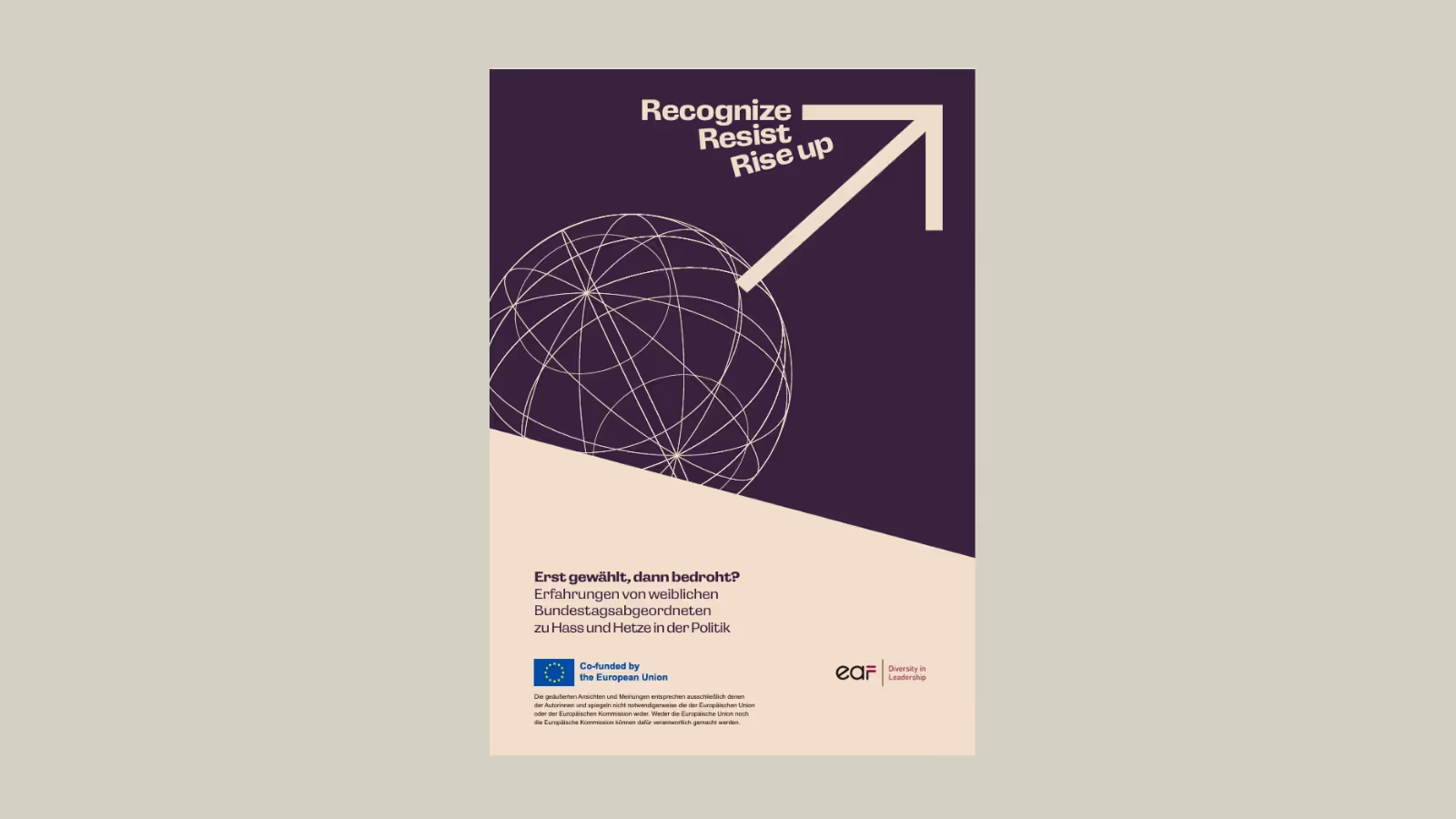
Sarah Robinson and Cécile Weidhofer: Elected, then threatened? Experiences of female Bundestag members regarding hate speech and harassment in politics. EAF Berlin, 2026.
.avif)