Too different for power? - How courageous women are fighting for equality in politics
Jetzt die PDF herunterladen.
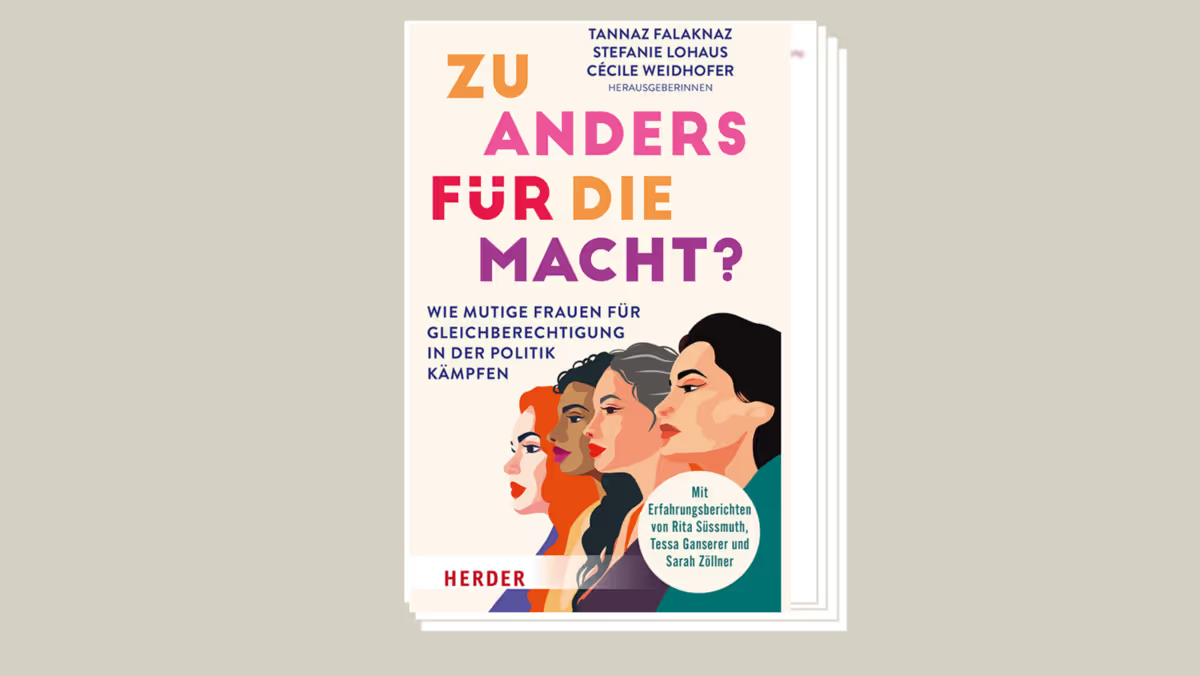
Elected officials and dedicated women share their experiences in this anthology. The collection was edited by Tannaz Falaknaz, Stefanie Lohaus, and Cécile Weidhofer from EAF Berlin.
Why haven't we achieved equality yet?
Gender equality in politics is stagnating. Too few women enter politics or participate in decision-making processes. Forms of communication, digital harassment, sexism, cutthroat mentalities, opaque appointment processes, intersectional discrimination, and the lack of compatibility between holding office and caregiving responsibilities are all deterrents. In this anthology, elected officials and committed women analyze these problems and share their experiences. The authors formulate a political agenda for greater equality and show how things can be done differently.
Interview with the editors
The book features contributions from a wide variety of authors on different topics. How did this selection come about?
"It was particularly important to us to let women in politics from all parties and age groups have their say, and to highlight both the differences and the commonalities. We feature reports from full-time and volunteer politicians: women who are new to politics and those who have shaped German politics for years—women without an elected mandate as well as those with one. We placed special emphasis on collaborating with women from both East and West Germany and ensured non-partisanship to include as many different perspectives as possible. Only through diverse perspectives can we gain a comprehensive view of the challenges. That is why the selection of authors is diverse, and we have given a voice to marginalized groups such as women with a migration background, trans women, and young women."
Do you think the topics addressed in the book can also be found in other areas of life?
"Yes, the topics and problems that exist in politics can be transferred to other areas of life. Ultimately, it is about power, women in leadership positions, and gender equality. Wherever people of different backgrounds, genders, and worldviews come together, tensions arise. The contributions on topics such as work-life balance and caregiving responsibilities, racism, age bias, and classism are therefore omnipresent in society. But politics is a public institution and affects us all. Politicians are frequently forced to justify themselves and rarely get the opportunity to constructively address the everyday hurdles faced by many people who want to get involved in politics."
Who are your role models in life?
"Our role models are all those courageous women in Germany, France, Iran, and everywhere else where women decide to do better and refuse to accept existing structures. Women who have made history by being the first to do something—whether 100 years ago or today—and who serve as examples to others, pave the way for the women who will follow them. But our role models are also those less visible women who fight daily, often at the local level, and do great political work—often unseen and unnoticed."
Who should definitely read your book?
"Everyone who cares about democracy should read this book. The authors describe, without sugarcoating, the problems that the system of representative democracy still faces. It highlights the measures and solutions necessary to overcome the hurdles that keep many from entering politics, staying in politics, or being able to shape politics at all. Therefore, this book is an important contribution to political education: What structures exist? What is otherwise not talked about? Which experiences need to be shared and contextualized? The book is suitable for those who want to delve deeper into the topic and are already sensitized, as well as for those who have had little contact with it so far and who we hope will be encouraged by the book to get involved."
Are there any topics that are not yet covered in this book but would deserve their own publication?
"One topic that is touched upon in the book, but to which we would like to dedicate more space, is mental health in politics. The regular headlines about politicians taking breaks or stepping down for health reasons illustrate that this is a more far-reaching problem that affects not just individual lives, but the political system as a whole. Society is not yet sufficiently sensitized to this, but it urgently needs to address what it means to be a politician, especially in the digital age: hate speech, the blurring of boundaries between space and time, 60-hour weeks, long travel and meeting times, a lack of work-life balance, and constant availability and visibility. A more comprehensive examination of this topic could offer important insights and solutions for the future."
"Zu anders für die Macht - Wie mutige Frauen für Gleichberechtigung in der Politik kämpfen" is published by Herder-Verlag and can be ordered here.
.png)