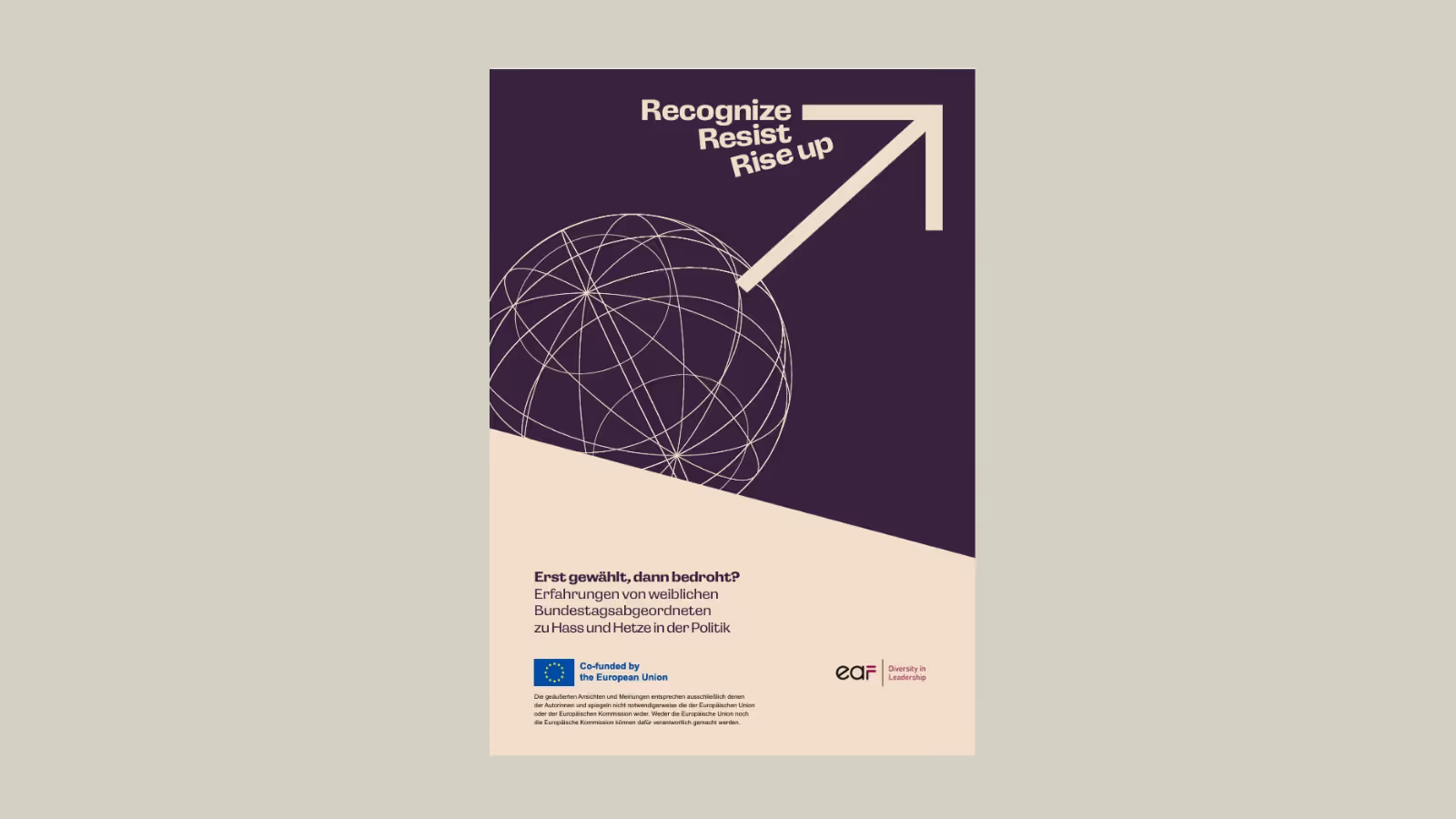
From Elected to Threatened
Jetzt die PDF herunterladen.
The EAF Berlin study “From Elected to Threatened: Experiences of Female Members of the German Bundestag Regarding Violence against Women in Politics ” surveyed current and former members of the Bundestag and highlights how hate, incitement, and gender-based violence influence political work. It becomes clear that these attacks do not merely target individual female politicians; they endanger political participation and, consequently, democratic representation. The study was produced as part of the European project “3R—Recognize, Resist, Rise Up: Tackling Gender-Based Violence against Women in Politics.”
Protests outside their homes, threats of physical violence, countless attacks via email or in comment sections. But also: sexual harassment within their own political party. Violence is a constant feature of daily life for many female politicians.
When Violence Becomes Part of Everyday Political Life
The study is part of a cross-national investigation into about female politicians in the national parliaments of Germany, the Czech Republic, Hungary, Ireland, and Slovakia. This non-representative sub-study shows that the female politicians surveyed experience all common forms of violence against women in their work as members of parliament: psychological, digital, sexual, physical, and financial violence. Female politicians report insults, threats, and digital violence particularly frequently—for example, in comment sections, emails, or messaging apps. Threats of rape, unwanted touching, sexualized comments, and damage to campaign posters or constituency offices are also described. For all the female politicians surveyed, receiving hateful comments or threats online as part of their mandate was a reality.
The personal is political—even when it comes to violence
Respondents report attacks that target not only their political views but explicitly their gender. Comments often refer to appearance, age, perceived competence, or traditional gender roles. Women, for example, are dismissed as “token women” or confronted with sexualized and misogynistic labels. The study thus highlights that political violence against women often has an explicitly gender-related dimension. Much of the hostility comes directly from citizens, organized groups, or digital spaces. However, respondents also report instances of boundary violations within political structures—such as in political parties, parliamentary caucuses, or parliamentary working groups. The study thus points to a problem that cannot be explained solely by external hatred, but also affects political institutions themselves at their very core.
Intersectionality: Hostility Is Often More Than Just Misogyny
Some accounts also show that attacks can—and often do—involve multiple forms of discrimination, meaning that they frequently target more than just the “characteristic of being a woman”—for example, when gender is linked to racist stereotypes, actual or perceived ethnicity, age, or physical appearance. Where is one actually safe anymore?
Boundary violations in the political workplace
It also becomes particularly clear that violence does not come only from outside. Some accounts point to sexist power games in the political workplace, such as within one’s own party or parliamentary group, or in parliamentary cooperation. The study highlights boundary violations within political structures. Respondents describe power games with sexist undertones, unwanted physical proximity, or remarks that are often downplayed. Perpetrators can thus easily claim misunderstandings rather than having to admit their own misconduct. This often results in the implication that a woman who defends herself is uncooperative, doesn’t have a sense of humor, or is simply too sensitive—frequently with consequences for her political career.
What Female Politicians Need Now: Protection, Support, and Accountability
The study provides insight into where female politicians turn for help and what their experiences have been. It becomes clear that the female politicians surveyed did not always feel well supported—whether by law enforcement, the legislature, or their own party. Based on the wishes of the participating female politicians, the authors propose, among other things, sensitive and consistent law enforcement, independent contact points and support structures, effective measures against sexism and discrimination in political parties and committees, as well as uniform regulations and their consistent implementation by platform operators in the EU. For one thing is clear: violence against female politicians is not an individual problem and is not a matter of the personal behavior of those affected. Protecting them requires a society-wide approach—with low-threshold counseling, consistent law enforcement, and structural measures that hold perpetrators accountable.
.avif)