Planner for better reconciliation of family, career, and local political office
Jetzt die PDF herunterladen.
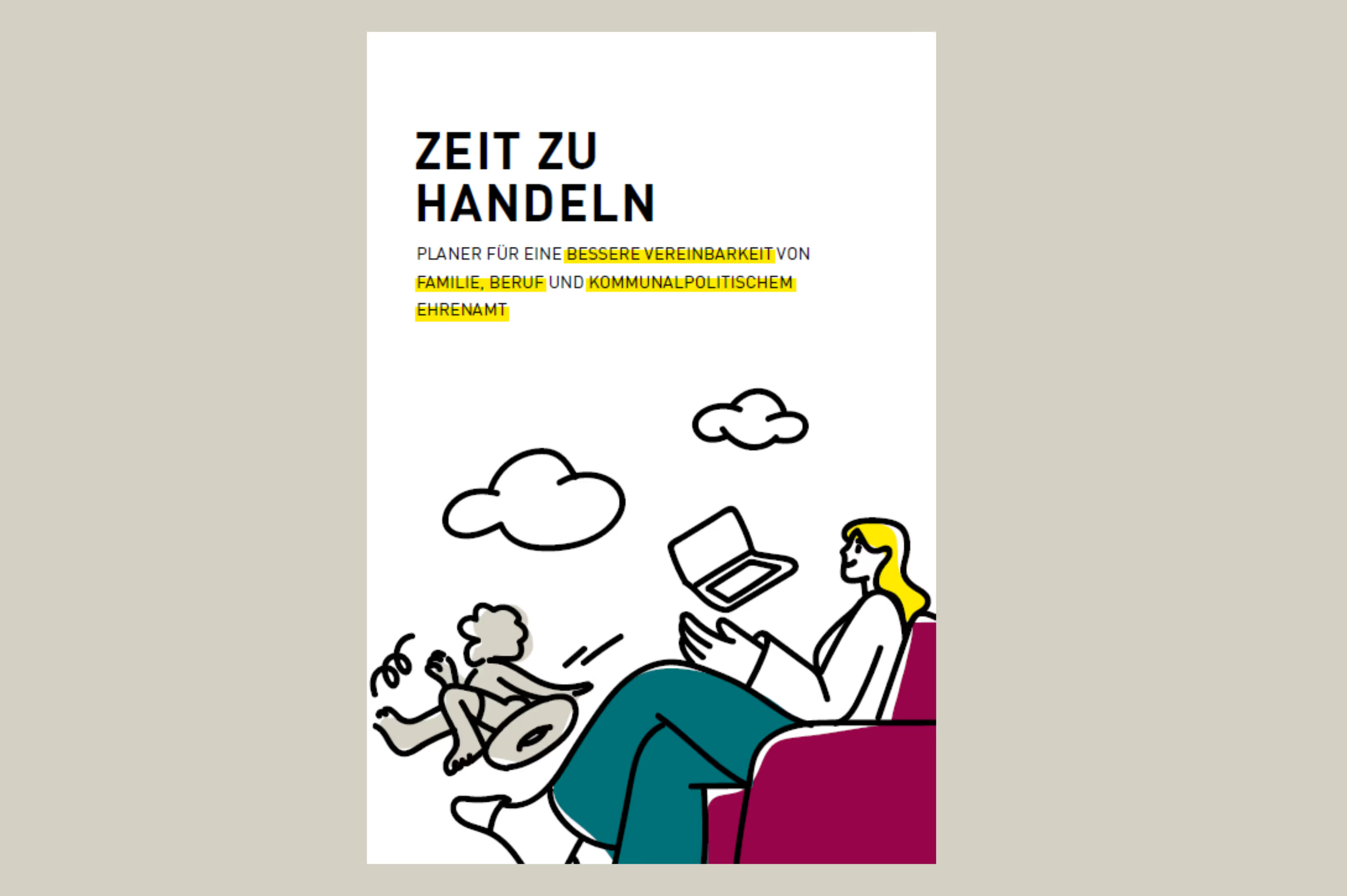
Germany is debating the first member of parliament to bring a baby to the lectern, with the President of the Bundestag calling for better work-life balance in parliament. Yet, local politics often lacks the structures needed to reconcile political engagement with caregiving responsibilities—even though they are urgently needed, given that women make up only about 30% of local representatives on average. Many municipalities have already found effective solutions, but these often remain isolated cases. With the new planner for better reconciliation of family, career, and local political office, the EAF Berlin, funded by the Federal Ministry for Women, offers a systematic and transferable approach for the first time to make local structures more family-friendly and diverse. This makes something possible that was previously missing: systematically adopting the successful experiences of other municipalities and adapting them to one's own conditions.
Turning knowledge into action
The planner is based on the EAF study "With Children in Politics," which was the first to analyze best practices from various municipalities across Germany. These findings have now been translated into a practical tool that helps municipalities examine their own frameworks and make targeted adjustments. "Many municipalities have already tested how to better achieve work-life balance in everyday political life—through family-friendly meeting times, childcare, or hybrid formats, for example. But these good examples often remain limited to individual locations," says author Cécile Weidhofer of the EAF Berlin. "We want to close this gap. The planner shows how successful approaches from other municipalities can be adapted to one's own reality." It bundles experiences, practical examples, and insights from discussions with local politicians, translating them into concrete checklists and reflection questions.
A tool for those shaping structures
The planner is aimed at everyone in administration or politics who holds responsibility and helps shape structures. It helps clarify central questions: What is the legal framework in my municipality? How do I ensure that local political work becomes family-friendly? Where is action needed, and what resources do we have? Every municipality, parliamentary group, or party can and should decide for itself which topics currently have priority, where action is needed, and what resources are available. The goal is to tackle suitable measures directly—step by step, at one's own pace, and with a view to the local reality. "Change is possible where the political will exists. With this planner, we are giving municipalities a tool to address work-life balance in a targeted way," says Cécile Weidhofer.
For our local democracy
Reconciliation cannot be achieved alone. It requires networking—within the municipality as well as across municipal boundaries. Different levels and stakeholders must be involved to create sustainable structures together. Only when everyone pulls in the same direction can structures emerge that enable genuine participation—and that strengthens our local democracy. The planner shows how collaboration between different political levels can succeed—from federal policy and municipal associations to civil society and research.
Continuing to make good practice visible
The current debate in the Bundestag shows how urgent this topic is—and that better work-life balance in politics must begin not just in Berlin, but everywhere. Municipalities that have already tested successful measures are invited to share their experiences: As part of the project "Frauen.Vielfalt.Politik." (Women.Diversity.Politics), implemented together with the German Rural Women's Association, the EAF Berlin is compiling best practice examples and making them visible at www.frauen-vielfalt-politik.de — so that even more municipalities can benefit from successful ideas.
Background
The planner is based on the study "Mit Kind in die Politik - Gute Praktiken für die Vereinbarkeit von Familie, Beruf und kommunalpolitischem Ehrenamt" (With Children in Politics - Best Practices for Reconciling Family, Career, and Local Political Office) by Cécile Weidhofer, Dorothea Walchshäusl, and Sarah Friedrich (2023). The content was revised in July 2025. Both were created as part of the Helene Weber-Kolleg, a project of the EAF Berlin funded by the Federal Ministry for Education, Family, Seniors, Women and Youth (BMBFSFJ).
Background
The planner is based on the study "Mit Kind in die Politik - Gute Praktiken für die Vereinbarkeit von Familie, Beruf und kommunalpolitischem Ehrenamt" (With Children in Politics - Best Practices for Reconciling Family, Career, and Local Political Office) by Cécile Weidhofer, Dorothea Walchshäusl, and Sarah Friedrich (2023). The content was revised in July 2025. Both were created as part of the Helene Weber-Kolleg, a project of the EAF Berlin funded by the Federal Ministry for Education, Family, Seniors, Women and Youth (BMBFSFJ).
.png)