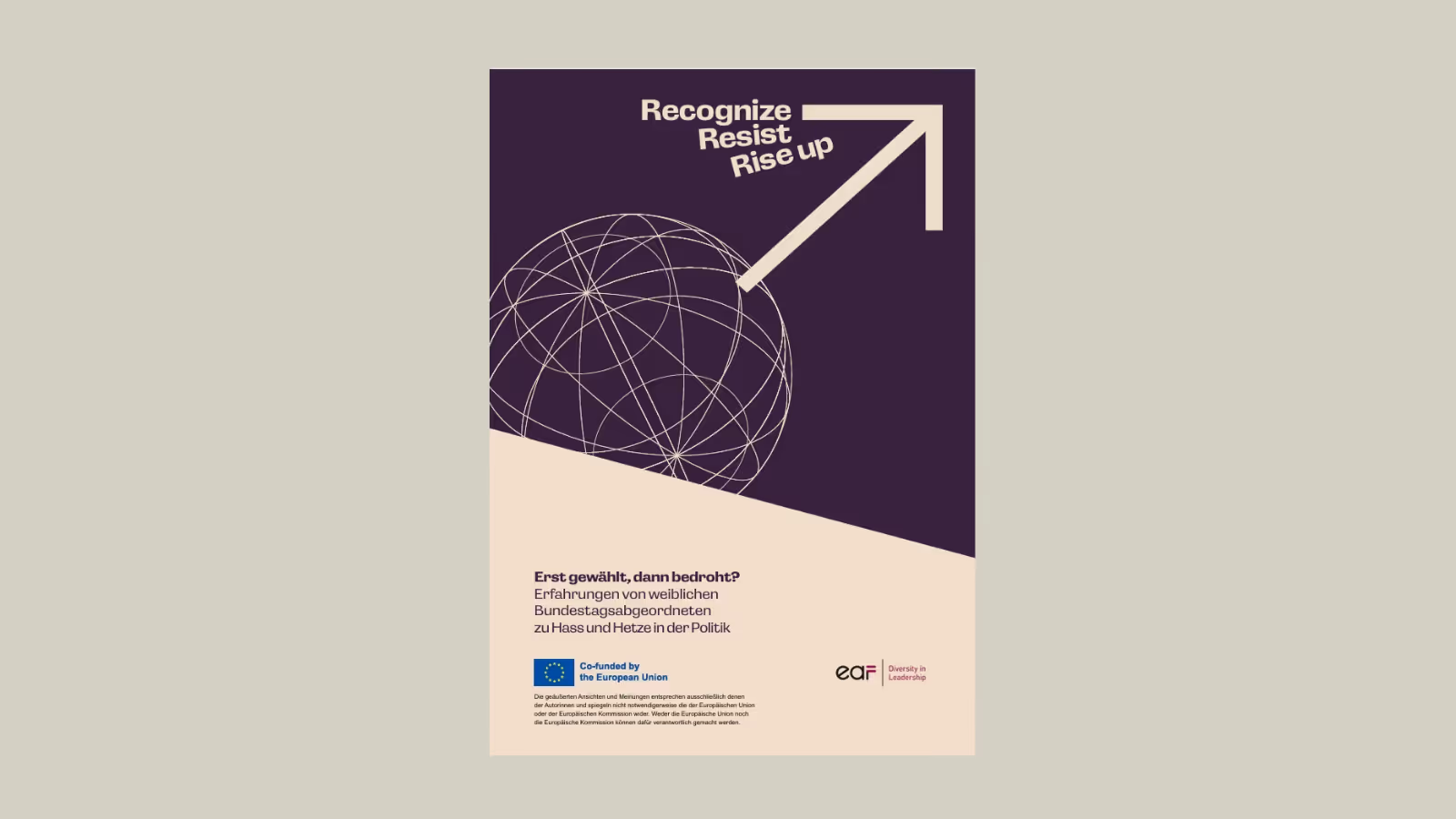
Women Power Berlin: Study on the political participation of women in Berlin

Jetzt die PDF herunterladen.
How has women's participation in Berlin politics evolved following the repeat election on February 12, 2023? What is the current proportion of women across all levels and functions? Who holds leadership positions? What are the underlying causes for the low representation of women? What role does electoral law play? And what conclusions can be drawn for increasing women's participation in Berlin politics? The authors examined the proportion of women in the Berlin House of Representatives and the district assemblies, analyzed these by party affiliation, and took a critical look at the discrepancy between the number of female candidates and the number of those elected. They also evaluated leadership positions at the Senate and district levels.
Surprise: New political balance of power means more women in the state parliament
Although parties were required to field the same candidates for the constituencies and party lists, the proportion of women in the Berlin House of Representatives increased by 3.6 percentage points to 39%. This moves Berlin to third place in the ranking of state parliaments, behind Hamburg and Bremen. The analysis by party reveals the decisive levers: electoral law and nomination practices. The shift in political majorities in favor of the CDU had a positive impact on the proportion of women. In 2023, the CDU won more constituencies where women had been nominated. As a result, twelve women were elected as direct candidates to the House of Representatives, compared to three previously. While the CDU parliamentary group still has a relatively low proportion of women at 25%, this is nearly double the 13% seen in 2021. The fact that more women are represented in parliament than in 2021 is due to the loss of SPD direct mandates, which primarily affected men: the proportion of women in the SPD group improved from 39% (2021) to nearly half (47%), as more women (16) entered the House of Representatives via the quota-based lists. The SPD parliamentary group now includes 16 women, two more than after the 2021 election.
Women significantly disadvantaged in constituency nominations
The personalized proportional representation system prevalent in Berlin, with its system of direct candidates for constituencies (first vote), can clearly impair women's chances of being elected. The figures show that in most parties—with the exception of the Greens—fewer women than men are nominated in the constituencies from the outset (on average 64% men compared to 36% women). Above all, men are more likely than women to be nominated in constituencies considered promising for the respective party. This applies primarily to the CDU, but also to the SPD.
The repeat election as an occasion and opportunity for a parity law
The 2023 Berlin election highlights the relevance of electoral law for equal participation and thus provides grounds for legislative action. Dr. Helga Lukoschat emphasizes: "Parity in parliaments is a central democratic concern. Our study clearly shows where the levers are: in the design of electoral law and in the parties' nomination practices."
The new Berlin state government has stated in the coalition agreement that it will examine the constitutional possibilities for a parity law. In doing so, the Berlin CDU is also positioning itself for the first time in favor of a law as a guarantor of truly equal participation. The Federal Constitutional Court has still not ruled on the fundamental constitutionality of parity laws. The constitutional debate remains controversial: in the Bundestag's electoral law commission, the pros and cons were roughly balanced. Furthermore, the commission has developed additional models that Berlin can build upon.
Overview of other key findings
- Quota-based lists work
Quota-based lists are once again proving to be an effective instrument. The binding internal regulations of the SPD and The Left regarding gender-balanced lists, as well as the 50% minimum quota for Alliance 90/The Greens, are having an impact. Non-binding regulations, such as the CDU's previous 30 percent quota, or the absence of regulations, as seen with the FDP and AfD, significantly reduce women's chances. - Alliance 90/The Greens and The Left have the highest proportions
The Green parliamentary group has the highest proportion of women; compared to 2021, it has even risen by another six percentage points from 53% to 59%. This means that 20 out of a total of 34 mandates are held by women. The proportion of women in The Left decreased from 54% to 50% because two women lost their constituencies. The party now holds only 22 mandates, which are split equally between men and women. - The FDP's exit improves the proportion of women, the AfD's presence worsens it
The FDP failed to clear the five-percent hurdle in the repeat election and is no longer represented in the House of Representatives. In 2021, the FDP filled only two of its twelve mandates with women, corresponding to a share of 17%. Since the FDP had fielded mostly men, its exit has also indirectly contributed to the increase in the proportion of women. The proportion of women in the AfD decreased again in 2023 by three percentage points to 12%. Of 17 seats, only two are held by women. - Leadership positions in the Senate – more female and more diverse
In 2021, the Berlin Senate led by Franziska Giffey (SPD) consisted of six female senators and four male senators. With Kai Wegner (CDU) as Governing Mayor, the Senate is now even more female-led, with seven female senators and three male senators. Including the Governing Mayor, the proportion of women remains at 64%, and at the level of state secretaries, it is 42%. The Berlin Senate is also more diverse than before. - Better starting position in the districts
In the district assemblies, the overall proportion of women has fallen slightly by 1.8 percentage points from 42.9% to 41.1% compared to the 2021 election. A comparison between districts shows Mitte in the lead with a share of 49.1%, while Spandau brings up the rear with 32.7%. Berlin is thus significantly above the German national average of 28% at the municipal level. Unlike in other federal states, elections for the district assemblies are generally held using a pure proportional representation system with fixed lists. Here, too, the combination of electoral law and the strength of parties with binding requirements is the decisive factor for women's participation. - Female mayors on the rise
Following the repeat election, seven out of twelve districts are led by a woman. This corresponds to a 58% share of women, an improvement of 25 percentage points compared to 2021. Four districts (Mitte, Marzahn-Hellersdorf, Pankow, and Reinickendorf) have joined the town halls previously led by women in Friedrichshain-Kreuzberg, Charlottenburg-Wilmersdorf, and Steglitz-Zehlendorf.
Order the print edition free of charge: Katrin Breston-Ziehlke: Katrin.Breston-Ziehlkefesde, Tel: 030 26935 7363
.avif)